

Sforza Castle History: Visconti Fortress to Modern Museum
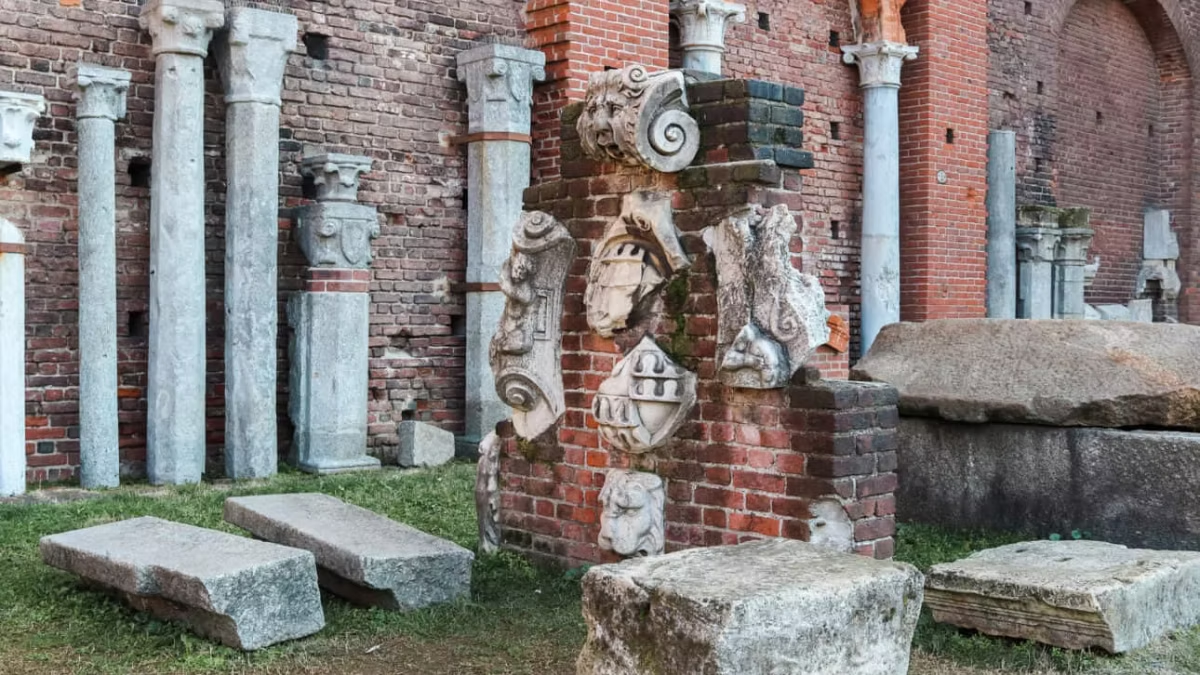
Sforza Castle began as the Visconti family’s Castello di Porta Giovia in 1358, was torn down in 1447, and was rebuilt from 1450 by Francesco Sforza as the seat of the new Sforza dynasty. Under Ludovico il Moro it became a Renaissance court decorated by Leonardo da Vinci and Bramante, before centuries as a foreign garrison left it battered and nearly demolished by the 1880s. Architect Luca Beltrami restored it around 1900, and after further damage in the 1943 bombing of Milan, it reopened as the museum complex that fills it today.
Few buildings in Milan carry as many layers of history as Sforza Castle. What stands in Piazza Castello today is not one building but the product of nearly 700 years of construction, destruction, rebuilding, military use, near-demolition, and careful restoration. Understanding that sequence makes a visit far more rewarding, because almost everything you see — from the tower over the main gate to the ceiling of a small room in the Corte Ducale — carries a specific date and a specific reason for looking the way it does.
This guide walks through that history in order, from the 14th-century Visconti fortress to the museum complex open to visitors in 2026.
The Visconti Fortress: Castello di Porta Giovia (from 1358)
The site’s first fortress, the Castello di Porta Giovia, was begun in 1358 by the Visconti family, who ruled Milan at the time. It stood at a gate in the city’s medieval walls and served as both a defensive stronghold and a residence for Milan’s rulers for nearly a century.
The castle’s story starts almost 700 years before today’s museums opened their doors. In 1358, Galeazzo II Visconti began building a fortress at the Porta Giovia, one of the gates in Milan’s medieval walls, on the northwest edge of the city. The Visconti family, who controlled Milan through the 14th century, used the fortress both to defend the city and to project their authority as rulers. Over the following decades it was expanded by later Visconti dukes, becoming a substantial fortified residence rather than a simple garrison post.
This original Castello di Porta Giovia is not the building you see today. It occupied roughly the same ground, and later construction reused parts of its foundations, but almost nothing of the 14th-century structure survives above ground. Its importance is historical rather than visible: it establishes that this corner of Milan had been a seat of power for a century before the Sforza family ever arrived.
Destruction After the Ambrosian Republic (1447)
The Visconti dynasty ended in 1447 with the death of Filippo Maria Visconti, the last Visconti duke, who left no male heir. Milan briefly became a self-governing city-state known as the Ambrosian Republic, and in a decisive break with the old order, the citizens tore down much of the Visconti fortress. The castle had come to symbolize ducal rule that the new republic wanted no part of, and demolishing it was as much a political statement as a practical decision.
The Ambrosian Republic proved short-lived, lasting only about three years before internal conflict and external pressure brought it down. But the demolition left the Porta Giovia site largely in ruins for a period, setting up the rebuilding that would follow under a new ruling family.
Francesco Sforza’s Rebuilding, from 1450
Francesco Sforza, a condottiero who became Duke of Milan in 1450, rebuilt the castle from the ground up on the ruins of the Visconti fortress, establishing it as the seat of the new Sforza dynasty. Construction continued for years under Sforza-employed architects and engineers, and the castle took the name it still carries today.
Francesco Sforza was a successful mercenary commander (condottiero) who married into the Visconti family and, after the Ambrosian Republic’s collapse, took control of Milan in 1450, founding the Sforza dynasty. One of his first major undertakings as duke was rebuilding the fortress at Porta Giovia, both to secure the city and to establish a residence befitting Milan’s new ruling family. Construction began in 1450 and continued for years, employing skilled architects and military engineers of the period.
The result was a much larger and more sophisticated fortress than the one it replaced, combining serious defensive engineering with the beginnings of the residential quarters that would later be decorated for Sforza court life. This is the building that gave the castle its name — Castello Sforzesco — and its basic layout, including the general footprint of the courtyards you can still walk through today.
The Golden Age: Ludovico il Moro, Leonardo, and Bramante
Under Duke Ludovico Sforza, known as Ludovico il Moro, who ruled Milan from 1494 to 1499, the castle reached its cultural peak as a Renaissance court. He employed both Leonardo da Vinci and Donato Bramante, and Leonardo painted the ceiling of the Sala delle Asse with an illusionistic canopy of interwoven mulberry branches.
The castle’s most celebrated period came under Ludovico Maria Sforza, better known as Ludovico il Moro, who effectively ruled Milan from the 1480s and formally became duke in 1494. Ludovico transformed the fortress his father had built into one of the most sophisticated courts in Renaissance Italy, drawing artists, architects, and scholars to Milan. Among them were two of the era’s greatest names: Leonardo da Vinci and the architect Donato Bramante, both employed at various points on projects connected to the castle and the wider Sforza court.
Leonardo’s best-known contribution inside the castle itself is the Sala delle Asse, a room in the Corte Ducale whose vaulted ceiling he painted with an illusionistic canopy of intertwined mulberry tree branches, their trunks appearing to grow from the corners of the room. The mulberry (gelso, or moro in the Milanese dialect of the period) was a visual pun on Ludovico’s own nickname, “il Moro.” Bramante’s influence is felt more broadly in the architectural language of the period, though attributing specific surviving castle structures to him with certainty is harder than the popular narrative sometimes suggests — write off any claim that seems too neat, and treat this as the era of Bramante’s presence in Milan rather than a room-by-room inventory of his work here.
This golden age ended abruptly. Ludovico il Moro lost Milan to French invasion in 1499 and died in French captivity in 1508, closing the most artistically ambitious chapter in the castle’s history almost as quickly as it had opened.
Foreign Rule: French, Spanish, and Austrian Citadel (1500s–1700s)
After Ludovico il Moro’s fall in 1499, the castle passed through French, Spanish, and Austrian control over roughly three centuries, and each power used it primarily as a military citadel and barracks rather than a ducal residence. This long military period reshaped much of the interior and added fortifications, but it also meant centuries of neglect for the Renaissance decoration inside.
Once Ludovico il Moro’s rule ended, the castle’s role changed fundamentally. French forces occupied Milan and used the castle as a military stronghold. Spanish rule followed in the 16th century and lasted roughly 150 years, during which the castle was absorbed into a broader system of city fortifications and functioned chiefly as a garrison. Austrian Habsburg rule took over in the 18th century after the War of the Spanish Succession, continuing the pattern of military occupation.
Across this long stretch — roughly the 16th through 18th centuries — the castle was primarily a barracks and citadel, not a residence or showpiece. Living quarters were repurposed for soldiers, defensive works were added and altered to suit changing military technology, and the kind of investment that had produced the Sala delle Asse simply stopped. This is the period in the castle’s history with the least glamour and, correspondingly, the least surviving decoration from its ducal years — much of what visitors admire today either predates this era or was restored well after it ended.
The 1521 Filarete Tower Explosion
One specific, dramatic event from this military period stands out: in 1521, a gunpowder explosion destroyed the Filarete Tower, the castle’s main gate tower, which had been built in the 15th century under Francesco Sforza and named for the architect Antonio Averlino, known as Filarete, credited with its design. The blast was severe enough to demolish the tower rather than simply damage it, and for the following centuries the main entrance to the castle stood without the landmark tower that had originally crowned it.
This is a useful detail for visitors today because the tower you photograph over the entrance from Piazza Castello is not the 15th-century original. It is a later reconstruction, built centuries after the explosion, and its story connects directly to the restoration work covered further down this page. For more on the tower and the castle’s other defensive structures, see our guide to the towers.
Decline and Near-Demolition in the 19th Century
By the 19th century, centuries of military use had left the castle in poor condition, and its reputation had shifted from ducal palace to unloved barracks. Milan changed hands repeatedly during this period amid the Napoleonic Wars and the broader movement toward Italian unification, and the castle continued to serve military functions rather than any cultural one. Its walls, courtyards, and surviving structures showed the wear of long neglect, and by the later 1800s there was real public and political discussion about demolishing the castle outright to make way for urban development in a rapidly modernizing Milan.
That the castle survived at all was not inevitable. It took a deliberate campaign — led by an architect who saw historical and civic value in the crumbling fortress rather than a demolition site — to change its fate.
Luca Beltrami’s Restoration (c. 1893–1905)
Architect Luca Beltrami led a major restoration of the castle beginning in the 1890s and continuing into the early 1900s, saving it from the demolition threat it faced and rebuilding the Filarete Tower, which had stood destroyed since the 1521 explosion. Beltrami’s work is why the castle we see today largely reflects a late-19th/early-20th-century idea of how the Sforza-era fortress should look.
Architect Luca Beltrami argued successfully against demolition and led a large-scale restoration project that ran from roughly 1893 to 1905. His work went well beyond patching up existing structures: Beltrami rebuilt the Filarete Tower, reconstructing the landmark gate tower that had stood in ruins since the 1521 gunpowder explosion, and restored substantial portions of the castle’s fabric based on his research into its Sforza-era appearance.
Beltrami’s restoration is one of the most consequential events in the castle’s entire history, because it directly shaped the building visitors walk into today. The Filarete Tower that appears in nearly every photograph of the castle from Piazza Castello is Beltrami’s reconstruction, not the 15th-century original. His broader restoration also recovered the castle’s civic standing, turning it from a barracks under threat of demolition into a monument worth preserving — and, soon after, a home for museums.
WWII Bombing (1943) and Postwar Restoration
Allied bombing of Milan in 1943 damaged parts of the castle during the Second World War. Postwar restoration repaired the structure and, notably, involved the architecture firm BBPR in redesigning several of the museum spaces, shaping the modern presentation of the collections inside.
The castle’s history of damage and rebuilding did not end with Beltrami. Milan suffered heavy Allied bombing during the Second World War, and the 1943 raids caused damage to parts of the castle, adding another layer to a building that had already survived demolition, an explosion, and centuries of military wear. Restoration in the postwar years addressed this damage and, at the same time, reimagined how the castle’s growing museum collections should be displayed.
The Milanese architecture firm BBPR (Banfi, Belgiojoso, Peressutti, and Rogers) played a significant role in this postwar phase, redesigning museum spaces within the castle with a modernist sensibility that contrasted deliberately with the historic architecture around it. Their work on the display of the Rondanini Pietà, in particular, is well known among visitors familiar with the museum’s history. This postwar period effectively completed the castle’s transformation from military citadel to cultural institution.
The Museum Complex Today
That long process — Visconti fortress, Sforza rebuild, Renaissance golden age, centuries as a garrison, near-demolition, Beltrami’s restoration, wartime damage, and postwar renewal — is why Sforza Castle today functions as it does: a set of largely free public courtyards and ramparts wrapped around a paid museum complex. The Musei del Castello Sforzesco now occupy much of the interior, spanning the Museum of Ancient Art, the Pinacoteca, the Museum of Decorative Arts, the Museum of Musical Instruments, the Egyptian Museum, prehistoric collections, and Michelangelo’s unfinished Rondanini Pietà, alongside Leonardo’s restored Sala delle Asse.
Walking the courtyards costs nothing and requires no ticket, a distinction that traces directly back to this history: the grounds are the surviving footprint of a working fortress and residence, while the museums are a later, 20th-century addition built into that historic shell. Keeping both facts in mind — free grounds, ticketed museums, and a building that has been destroyed and rebuilt more than once — is the best way to appreciate what you are actually looking at on a visit.
Frequently Asked Questions
When was Sforza Castle originally built?
The site’s first fortress, the Castello di Porta Giovia, was begun in 1358 by the Visconti family, who ruled Milan at the time. That original structure was demolished in 1447, and the castle seen today dates mainly from the rebuilding that began in 1450 under Francesco Sforza.
Who built Sforza Castle?
Francesco Sforza, a former mercenary commander who became Duke of Milan in 1450, rebuilt the castle on the ruins of the earlier Visconti fortress, giving it the name Castello Sforzesco. Later dukes, especially Ludovico il Moro, expanded and decorated it further.
Why is it called Sforza Castle?
It takes its name from the Sforza family, who ruled Milan as dukes starting with Francesco Sforza in 1450. He rebuilt the fortress after the Visconti-era structure was torn down in 1447, and it remained the Sforza dynasty’s seat for decades afterward.
Did Leonardo da Vinci work on Sforza Castle?
Yes. Leonardo da Vinci worked for Duke Ludovico il Moro in Milan in the late 15th century and painted the ceiling of the Sala delle Asse, a room inside the castle, with an illusionistic design of interwoven mulberry branches. The room is part of the museum complex today, though it periodically closes for restoration.
What happened to the Filarete Tower?
The original Filarete Tower, built in the 15th century over the castle’s main entrance, was destroyed by a gunpowder explosion in 1521 and stood in ruins for centuries afterward. The tower visible today is a reconstruction built by architect Luca Beltrami as part of his restoration around 1900.
Was Sforza Castle almost demolished?
Yes. By the second half of the 19th century, after centuries of use as a military barracks left it in poor condition, there was serious public discussion about tearing the castle down as Milan modernized. Architect Luca Beltrami argued against demolition and instead led a restoration between roughly 1893 and 1905 that saved the building.
Was Sforza Castle damaged in World War II?
Yes. Allied bombing raids on Milan in 1943 caused damage to parts of the castle. It was restored after the war, a phase that also involved the architecture firm BBPR reshaping several of the museum spaces inside.
When did Sforza Castle become a museum?
The castle’s museums developed over the 20th century, building on Luca Beltrami’s structural restoration around 1900 and expanding significantly with postwar work, including redesigns by the BBPR architecture firm. Today it houses the full Musei del Castello Sforzesco collection, covered by one combined ticket.
Is Sforza Castle the original building from the 1400s?
Not entirely. The castle has been destroyed and substantially rebuilt more than once — the Visconti fortress was demolished in 1447, the Filarete Tower was destroyed in 1521 and rebuilt around 1900, and parts of the structure suffered further damage in 1943. What stands today combines genuine Sforza-era fabric with major later reconstruction, especially Beltrami’s restoration.
How long did the Sforza family control the castle?
The Sforza dynasty held Milan and the castle from Francesco Sforza’s takeover in 1450 until Ludovico il Moro’s fall to French invasion in 1499, with a brief later restoration of Sforza rule afterward before foreign powers took lasting control in the 16th century.
