

Michelangelo’s Rondanini Pietà: Sforza Castle’s Masterpiece
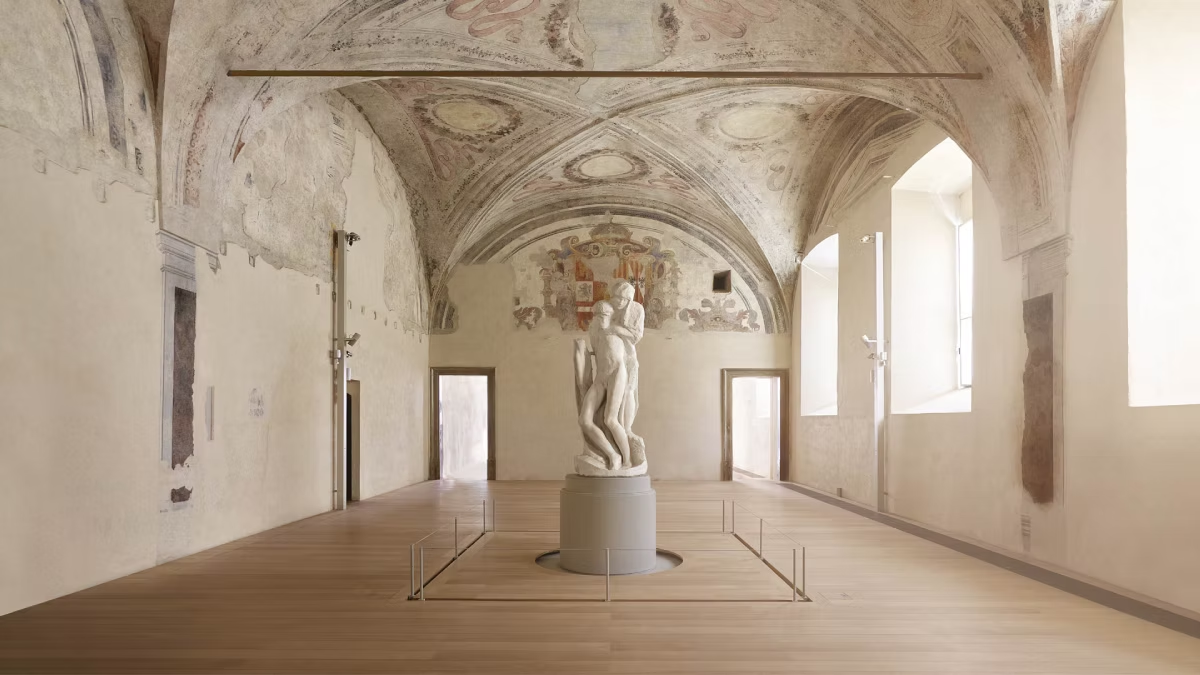
The Rondanini Pietà is Michelangelo’s final sculpture, left unfinished when he died in 1564 at age 88. Radically reworked and abstract, it shows the Virgin Mary supporting the body of Christ in a raw, elongated form far from classical sculpture. It is displayed in its own dedicated hall in the former Spanish Hospital (Ospedale Spagnolo) at Sforza Castle, covered by the €5 combined museums ticket.
Of everything inside Sforza Castle, no single object stops visitors the way the Rondanini Pietà does. It is not polished or heroic in the way the Sistine ceiling or the Rome Pietà are — it is rough, incomplete, and quietly devastating. Michelangelo was still working the marble days before he died, and what he left behind is one of the most personal, unresolved works in Western sculpture.
This guide explains what the Rondanini Pietà is, why its unfinished, non-classical form is so moving, how to read the two figures carved into the same block, its journey from a Roman palace to Milan, and how to find its dedicated gallery inside the castle.
Michelangelo’s Last Sculpture
Michelangelo began carving this block of marble around 1552, when he was in his late seventies, and he kept returning to it, on and off, for more than a decade. According to accounts from the time, he was still working on the figures within about a week of his death in Rome on February 18, 1564. No other major work by him is so directly tied to his final days, which is part of why the sculpture carries the weight it does — it was, quite literally, the last thing on his mind.
The title comes not from its subject but from a much later owner: the Marchesi Rondanini, whose Roman palace held the piece for generations before it came to Milan in the twentieth century (see the history below). The subject itself is the Pietà, the image of the Virgin Mary holding or supporting the dead body of Christ — a theme Michelangelo had already treated, famously and very differently, in the polished, classically balanced Pietà now in St. Peter’s Basilica, which he carved as a young man in his early twenties.
An Unfinished, Non-Classical Form
The Rondanini Pietà abandons the naturalistic anatomy and calm balance of Michelangelo’s earlier work. The figures are elongated, compressed together, and left with visible chisel marks and rough, unresolved surfaces — an aesthetic closer to twentieth-century expressionist sculpture than to Renaissance classicism.
What makes the Rondanini Pietà so different from the rest of Michelangelo’s output is precisely what it lacks: the confident, idealized musculature and clear compositional geometry of his earlier religious works. Here, Christ’s body is thin and stretched, almost weightless, and Mary’s figure rises directly behind and above him rather than cradling him across her lap. The two seem to merge into a single vertical shape, their forms fused at points where the chisel has not fully separated them.
Large areas of the stone are left rough, with toolmarks still visible, and the proportions are deliberately or accidentally distorted — it’s often impossible to tell which, since Michelangelo was reworking the piece even as he abandoned earlier decisions. That ambiguity is central to its power. Viewers and scholars have long read the sculpture as a meditation on mortality, faith, and the limits of the body, made all the more affecting by the fact that its maker died before he could resolve it. It is not a work of triumphant mastery; it is a work of searching, left mid-sentence.
Two Figures in One Block
Look closely and you can see two distinct compositional states in the same marble: an earlier, more conventionally muscular figure of Christ — whose separately carved right arm and leg remain, disconnected from the final pose — and the later, radically reworked, elongated figures Michelangelo carved over and around them.
This is the detail that rewards a slow look rather than a quick photo. Michelangelo did not simply add material as he went; he cut away and reconceived the composition more than once. A remnant of an earlier, more classically proportioned right arm — thought to belong to an earlier stage of the Christ figure — still projects from the block, seemingly disconnected from the body it once belonged to, like a ghost of the sculpture Michelangelo chose to abandon. Traces of an earlier, more muscular pair of legs are likewise visible lower on the block, out of step with the slender figure standing above them.
Reading these two states side by side — the discarded, more naturalistic first attempt and the final, pared-down, almost abstract reworking — is the closest anyone gets to watching Michelangelo change his mind. It’s worth circling the sculpture slowly (the display allows viewing from multiple angles) to pick out both layers before stepping back to take in the whole.
History: From the Rondanini Palace to Milan
Michelangelo left the sculpture unfinished in his Roman studio at his death in 1564. It passed out of his estate and, by the eighteenth century, into the collection of the Marchesi Rondanini family, who displayed it in their Roman palace for roughly two centuries — which is where the sculpture’s name comes from, rather than from its subject. It remained relatively little known to the wider public during this long private ownership.
The City of Milan acquired the sculpture in 1952, and it was moved from Rome to the Museum of Ancient Art inside Sforza Castle, where it has remained ever since as one of the collection’s centerpieces. Its arrival in Milan gave the Rondanini Pietà a far wider public than it had known in centuries of private ownership, and it has been one of the castle’s most visited single works since. For more on how the castle’s collections came together over the centuries, see our history of Sforza Castle.
The Museo Pietà Rondanini: The Former Spanish Hospital
For decades the sculpture was shown within the Museum of Ancient Art’s general galleries. It now has its own dedicated space: a purpose-built display inside the former Spanish Hospital (Ospedale Spagnolo), a wing of the castle originally used as an infirmary during the Spanish period of its history. The room was reworked as a gallery devoted solely to the Pietà, with a museography associated with the influential postwar Milanese architecture studio BBPR — a deliberately spare, contemplative setting, with the sculpture set apart so it can be viewed in the round and in relative quiet, away from the busier picture galleries.
The effect of a single object in a room built around it is part of the experience. Rather than competing with other sculpture or paintings, the Pietà stands alone, lit simply, letting visitors approach slowly and view it from the front, the sides, and behind — useful, given how much of the sculpture’s meaning lies in comparing the earlier and later carved states described above.
How to Find It
The Museo Pietà Rondanini sits within the Museum of Ancient Art circuit, in the former Spanish Hospital wing, reached from the Corte Ducale courtyard. Castle staff and signage direct visitors along the museum route; if you’re short on time and want to head straight there, ask at the ticket desk or information point near the entrance, since the collections are large enough that a first-time visitor can otherwise spend a while finding it. A castle map or the printed floor plan available at entry also helps with orientation.
The sculpture is fully covered by the standard combined museums ticket, priced at roughly €5 full price / €3 reduced, with under-18s free — there is no separate charge to see it and no extra ticket to buy. That single ticket also covers the Pinacoteca, the Museum of Decorative Arts, the Egyptian and Prehistoric collections, and, access permitting, Leonardo’s Sala delle Asse. Remember that the museums are closed on Mondays, while the castle’s courtyards remain free and open every day. Full details on pricing and free-entry days are in our entry ticket guide.
Best Time to See It Quietly
The Rondanini Pietà is one of the castle’s most photographed and most written-about works, and its dedicated room can fill up, especially mid-morning to early afternoon and on the free first Sunday of the month. For a quieter visit, arrive close to the museums’ 10:00 AM opening on a weekday, or come in the later part of the afternoon, closer to last entry at 5:00 PM, when tour groups have generally moved on. Weekday visits outside Italian school holidays are consistently calmer than weekends.
If you’d rather have context provided on the spot, a guided Pietà Rondanini Tour pairs entry to the castle with a guide who can walk through the sculpture’s two carved states and its history in person — useful if you want the detail without researching it yourself first.
Viewing Tips
Give the sculpture more time than you think you need. Because it rewards close looking — the earlier arm and legs, the toolmarks, the way the two figures merge — a fast walk-through misses most of what makes it remarkable. Circle it slowly if the room allows, compare the rough and the refined passages, and step back for the full silhouette before moving on. Photography is generally permitted without flash, as elsewhere in the museums, but flash and tripods disturb both the conservation conditions and other visitors, so keep phones on silent settings and avoid flash. Because the room is built around a single object, it also tends to be one of the quieter, more contemplative stops in the whole museum circuit — worth treating as a dedicated pause in your visit rather than a quick photo stop en route to the next gallery.
Frequently Asked Questions
What is the Rondanini Pietà?
It is Michelangelo’s final sculpture, an unfinished depiction of the Virgin Mary supporting the body of Christ, which he worked on intermittently from around 1552 until close to his death in 1564. It is now housed in a dedicated gallery inside Sforza Castle’s Museum of Ancient Art.
Where is the Rondanini Pietà located?
It is displayed in the Museo Pietà Rondanini, a purpose-built room inside the former Spanish Hospital (Ospedale Spagnolo) wing of Sforza Castle, reached from the Corte Ducale courtyard within the Museum of Ancient Art circuit.
Is the Rondanini Pietà included in the Sforza Castle ticket?
Yes. It is fully covered by the standard combined museums ticket, roughly €5 full price and €3 reduced, with no separate admission fee. That same ticket covers all of the castle’s museums and collections.
Why is the Rondanini Pietà unfinished?
Michelangelo was still reworking the marble in the days before his death in February 1564, at age 88, and never returned to complete it. The unresolved, rough surfaces and shifting proportions are the direct result of that interrupted work.
How is the Rondanini Pietà different from Michelangelo’s other Pietàs?
Unlike his youthful, classically balanced Pietà in St. Peter’s Basilica, the Rondanini version abandons naturalistic anatomy for elongated, compressed, almost fused figures with visible toolmarks. It is generally read as a far more abstract, personal, and spiritually raw treatment of the same subject.
What are the two figures visible in the marble?
Look closely and you can see a discarded earlier state — a more muscular right arm and pair of legs from an earlier version of Christ — alongside the final, slender, reworked figures Michelangelo carved over them. Both states remain visible in the same block.
When did the Rondanini Pietà come to Milan?
The sculpture passed from Michelangelo’s estate into the Rondanini family’s Roman palace, where it remained for roughly two centuries, before the City of Milan acquired it in 1952 and moved it to Sforza Castle.
What is the Ospedale Spagnolo?
It is the former Spanish Hospital, a wing of Sforza Castle originally used as an infirmary, which has been converted into a dedicated gallery for the Rondanini Pietà alone, with a spare, contemplative museography associated with the BBPR architecture studio.
How long should I spend viewing the Rondanini Pietà?
Most visitors pause for five to fifteen minutes, though the sculpture rewards a slower look at its two carved states and its surfaces from multiple angles. Build a few extra minutes into your museum visit if this is a highlight for you.
