

Sforza Castle Towers: Filarete, Bona & the Corner Bastions
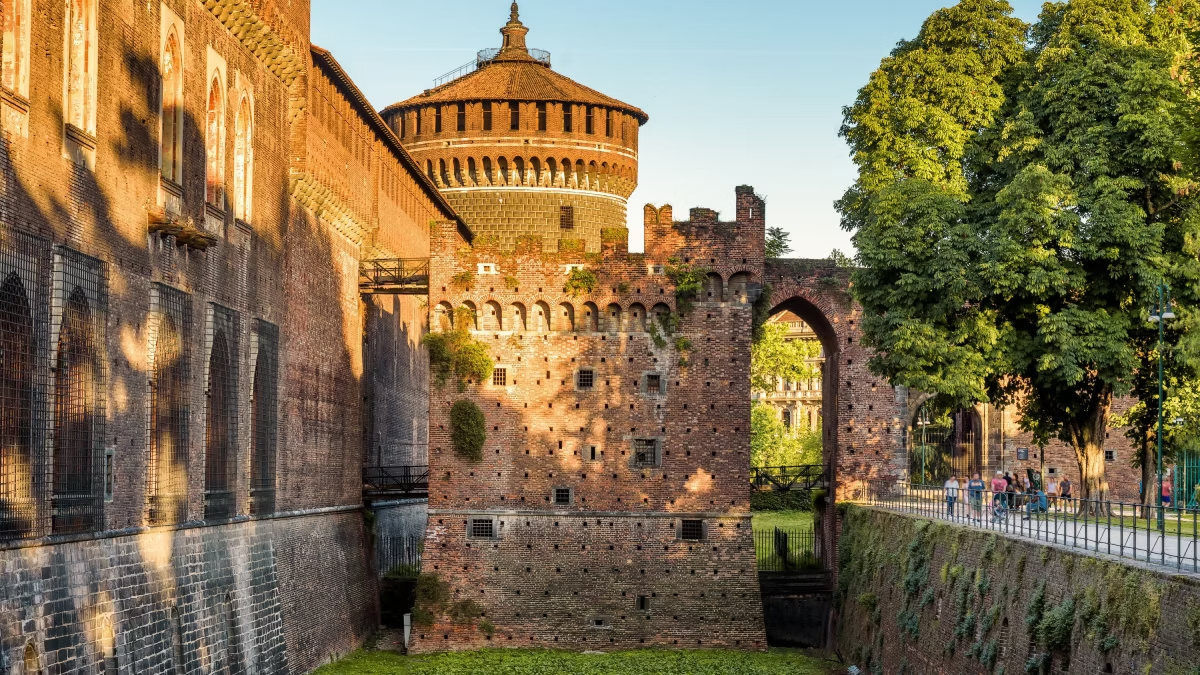
Sforza Castle’s skyline is defined by the central Filarete Tower over the main gate — a 1905 reconstruction of the original, which was destroyed by a gunpowder explosion in 1521 — plus the round Torre di Bona di Savoia at the rear, two round corner towers (Castellana and Carmine), and the later star-shaped Spanish bastions. Almost all of them are viewed from outside; you walk through and around them rather than climbing them.
Sforza Castle’s towers are what make it recognizable from across Piazza Castello: the tall, castellated Filarete Tower framing the main entrance, and the sturdier round towers anchoring the corners and the far end of the citadel. Each has its own history, and none of it is what it first appears — the tower most photographed today is barely a century old, while a couple of the round ones have stood, largely unchanged, since the 1450s.
This guide walks through each tower in turn: what it looked like originally, what happened to it, and what to look for when you’re standing in front of it.
The Filarete Tower (Torre del Filarete)
The Filarete Tower is the tall central tower over Sforza Castle’s main gate, facing Piazza Castello. It’s named for the Renaissance architect Antonio Averlino, known as “Il Filarete,” who designed the original 15th-century tower — but the tower you see today is a 1905 reconstruction by Luca Beltrami, built as a memorial after the original was destroyed in 1521.
The Filarete Tower is the castle’s most photographed feature and its de facto symbol: a tall, square, crenellated tower rising directly above the main entrance arch, with a clock face and a slim campanile-like top section. It sits on the town-facing side of the castle, opposite Piazza Castello, and is the gate visitors walk through to reach the Piazza d’Armi, the great parade ground inside.
The original tower was designed under Francesco Sforza in the mid-15th century and is traditionally credited to Antonio Averlino, the architect and sculptor nicknamed “Il Filarete,” who worked for the Sforza court and wrote an influential treatise on architecture. His tower stood as the ceremonial entrance to the ducal castle for decades — until disaster struck in 1521. A store of gunpowder kept inside the tower exploded, most likely from an accident during the Spanish military occupation of the castle, and the blast destroyed the tower completely. For nearly four centuries afterward, the castle’s main facade had no central tower at all; the gate remained, but the skyline above it was flat.
The tower’s return came almost 400 years later, in an entirely different context. When Milan restored the neglected, barracks-worn castle around 1900, architect Luca Beltrami led the renovation and made rebuilding the Filarete Tower a centerpiece of the project. Completed in 1905, Beltrami’s tower isn’t a strict archaeological reconstruction — no detailed record of the original survives — but a careful, historically informed design based on period images, drawings, and comparable Sforza-era towers, built explicitly as a monument to the castle’s Renaissance origins. It’s worth knowing this when you look up at it: what appears to be the castle’s oldest feature is, structurally, one of its youngest.
What to look for: the equestrian statue niche and coat-of-arms detailing on the facade, the clock (a later, functional addition), and the way the tower’s height and verticality contrast with the squatter, older round towers elsewhere on the site — a visible difference between 15th-century military architecture and Beltrami’s more decorative, symbolic 1905 rebuild.
The Bona of Savoy Tower (Torre di Bona di Savoia)
The Torre di Bona di Savoia is a round tower at the rear of the castle, on the Rocchetta side facing Parco Sempione, and it’s one of the parts of the complex that has survived largely intact since the Sforza period, unlike the Filarete Tower. It takes its name from Bona of Savoy, the wife of Duke Galeazzo Maria Sforza and regent of Milan after his assassination in 1476, who lived at the castle and is associated with this section of the fortifications.
Round in plan and built for defense rather than display, the tower has the thicker, lower-profile silhouette typical of 15th-century artillery-era fortification — a useful visual contrast to the tall, ornamental Filarete Tower at the opposite end of the site. It’s best appreciated from the Parco Sempione side, where you can see it rising directly from the old moat line, or from within the Rocchetta courtyard looking back toward the perimeter wall.
The Corner Towers: Castellana and Carmine
At two of the castle’s outer corners stand round towers built as part of the original 15th-century defensive circuit: the Torre Castellana (also known as the Torre di Santo Spirito) and the Torre del Carmine, named for nearby streets and a former church rather than for any person. Like the Bona Tower, these are round, thick-walled structures designed to hold artillery and deflect cannon fire, quite different in character from the tall, symbolic Filarete Tower.
These corner towers anchor the outer perimeter of the citadel — the outermost defensive ring, beyond the three inner courtyards — and are generally seen from the ramparts walk or from outside the walls rather than entered directly. They’re easy to miss if you head straight for the courtyards, so if towers are your main interest, take a slow lap around the castle’s exterior, along Via Beltrami or through the surrounding gardens, before or after your museum visit.
The Spanish Bastions and Star-Shaped Fortifications
Beyond the medieval and Renaissance towers, the castle also carries visible traces of a later phase of military engineering: the star-shaped bastions added under Spanish rule in the 16th and 17th centuries, when Milan was a Spanish possession and the castle was reinforced as a working citadel rather than a ducal residence. These angular, arrow-shaped bastion outworks — designed for defense against cannon in a way that round medieval towers no longer could withstand — extended the fortified perimeter well beyond the original Sforza walls into what is now Parco Sempione.
Most of the outer Spanish fortifications were demolished in the 19th century as Milan expanded and the park was laid out, so you won’t find a complete star fort today. What remains are fragments — sections of bastion wall, ditch lines, and earthworks incorporated into the park’s landscaping — best appreciated with a bit of context rather than expected to look dramatic on their own. If military architecture interests you, look for the change in stonework and angle where Sforza-era construction gives way to the flatter, more angular Spanish additions.
The Torre di Bramante
The Torre di Bramante, inside the Rocchetta (the innermost, most secure courtyard of the castle), is traditionally associated with Donato Bramante, the architect who worked in Milan for Ludovico Sforza before his more famous Roman career designing part of St. Peter’s Basilica. The attribution isn’t fully documented — as with several Sforza-era structures, records are incomplete — but the tower is consistently linked to Bramante in castle literature and forms part of the Rocchetta’s defensive and residential architecture.
Because it sits within the Rocchetta, this tower is closer to the museum route than the perimeter towers, and its Renaissance proportions and detailing reward a slower look if you’re already inside for the Museums or Rondanini Pietà.
Can You Climb the Towers?
No — visitors do not climb the Filarete Tower, the Bona Tower, or the corner towers. They’re viewed and photographed from the courtyards, ramparts, and surrounding grounds, not entered as standalone attractions with public viewing platforms.
Sforza Castle’s towers are architectural and historical landmarks, not visitor attractions with staircases and lookout points. You experience them by walking through the Filarete Tower’s gate arch, by viewing the round towers from the courtyards or from outside the walls, and by looking up at the Torre di Bramante as you move through the Rocchetta. This is worth knowing if a tower climb with a view over Milan is what you’re hoping for — Sforza Castle isn’t that kind of stop, though the free grounds still make it a rewarding one for anyone interested in fortification and Renaissance architecture. For the interior collections reachable from the Rocchetta and Corte Ducale, see our guide to what to see inside.
Photo Tips
The classic shot of the Filarete Tower is from Piazza Castello, straight on, ideally in the soft light of early morning or the last hour before sunset when the facade catches warm light and the piazza is less crowded with traffic and pedestrians. Walking through the gate arch and turning back for a shot from inside the Piazza d’Armi gives a different, more dramatic angle, especially with the sky behind the tower. For the round towers — Bona, Castellana, and Carmine — the Parco Sempione side generally gives cleaner, less obstructed views than the street side, and the old moat line adds useful depth to the composition. If you want the whole castle silhouette, including the corner towers and bastions together, the open lawns of Parco Sempione, a short walk back from the walls, are the best vantage point.
History in Brief
The towers trace the castle’s whole arc: the original Filarete Tower and the round corner and rear towers date to the ambitious 1450s rebuilding under Francesco Sforza, on the site of the earlier 14th-century Visconti fortress. The Spanish bastions came later, in the 16th and 17th centuries, as artillery made round medieval towers less effective and military engineering shifted toward angular, low-profile star forts. The 1521 gunpowder explosion that destroyed the original Filarete Tower left the castle without its central landmark for nearly 400 years, through periods as a barracks and garrison under Spanish and Austrian rule, until Luca Beltrami’s turn-of-the-century restoration rebuilt it as part of transforming the castle from military relic into civic monument and museum complex. For the fuller narrative, see our history of Sforza Castle.
Frequently Asked Questions
Is the Filarete Tower the original from the 15th century?
No. The original tower, designed under Francesco Sforza and credited to Antonio Averlino (“Il Filarete”), was destroyed in 1521 when stored gunpowder exploded inside it. The tower standing today was rebuilt in 1905 by architect Luca Beltrami as part of his restoration of the castle, based on historical research rather than surviving original plans.
Why did the original Filarete Tower explode?
A store of gunpowder kept inside the tower, most likely during the Spanish military occupation of the castle, exploded in 1521 and destroyed the structure. The exact cause is not precisely documented, but it’s consistently described as an accidental powder-magazine explosion rather than an attack.
Can you go inside or climb the Filarete Tower?
No. Visitors pass through the arch beneath it to enter the castle grounds, but the tower itself is not open as a climbable viewpoint. It’s viewed and photographed from Piazza Castello outside and from the Piazza d’Armi inside.
Who was Bona of Savoy?
Bona of Savoy was the wife of Duke Galeazzo Maria Sforza and served as regent of Milan for her young son after Galeazzo’s assassination in 1476. The round tower at the rear of the castle, facing Parco Sempione, carries her name.
What are the round corner towers called?
The two round corner towers are the Torre Castellana (also called the Torre di Santo Spirito) and the Torre del Carmine, both part of the original 15th-century defensive perimeter. They’re best seen from the ramparts or the exterior grounds rather than from inside the museum route.
Is the Torre di Bramante really by Bramante?
The tower in the Rocchetta is traditionally attributed to Donato Bramante, who worked in Milan for Ludovico Sforza before moving to Rome, but the attribution rests on tradition and stylistic association rather than complete documentary proof.
Do I need a ticket to see the towers?
No. All of the towers — the Filarete Tower, the Bona Tower, the corner towers, and the Spanish bastion remains — are visible for free from the courtyards, ramparts, and surrounding grounds. Only the museums inside the castle require the paid ticket, and the towers themselves aren’t part of the ticketed collections.
What’s left of the Spanish bastions?
Most of the star-shaped Spanish fortifications were demolished in the 19th century when Parco Sempione was laid out. What remains are fragments of bastion wall and earthworks incorporated into the park landscape, visible if you know roughly where to look but not a complete star fort.
Where’s the best place to photograph the towers?
Piazza Castello, straight on, gives the classic view of the Filarete Tower, especially in early morning or late-afternoon light. For the round towers and the overall castle silhouette, the open lawns of Parco Sempione on the far side generally offer the cleanest, least obstructed views.
How long does it take to see all the towers?
Walking the exterior perimeter and courtyards to take in the Filarete Tower, the Bona Tower, the corner towers, and the Torre di Bramante takes about 20–30 minutes at an easy pace, on top of whatever time you spend in the courtyards or museums. It pairs naturally with a walk of the ramparts.
