

Parco Sempione & Arco della Pace: Sforza Castle Park Guide
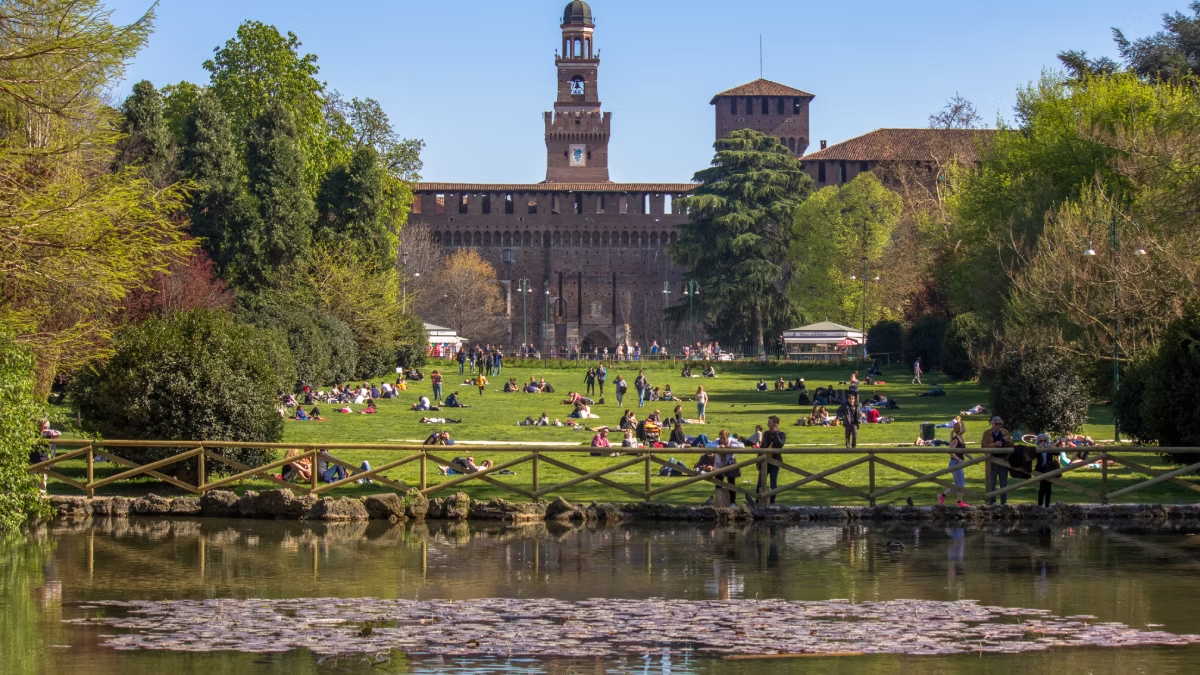
Parco Sempione is the large, English-style park directly behind Sforza Castle, laid out in the late 1800s by architect Emilio Alemagna. It’s free and open daily, and holds a lake, the Torre Branca panoramic tower, the Triennale design museum, the Civic Aquarium, playgrounds, and the neoclassical Arco della Pace (Arch of Peace) at its far end. You can walk straight through from the castle’s Rocchetta side, making the two an easy combined visit.
Sforza Castle doesn’t end at its own ramparts. Pass through the Rocchetta courtyard on the north side and you walk out of one of Europe’s largest citadels straight into one of Milan’s largest green spaces. Parco Sempione unfolds for nearly 40 hectares between the castle and the Arco della Pace, and unlike the castle’s museums, every corner of it is free.
This guide covers what the park was built for, what’s actually inside it — the lake, the towers, the museums, the playgrounds — the history of the Arco della Pace at its far end, and how to fold both into a single, unhurried visit.
Parco Sempione at a Glance
Parco Sempione sits on what was, for centuries, the Sforza family’s private hunting ground and later a military parade ground behind the castle. In the late 19th century, as Milan modernized for the 1906 international exposition era, the city hired architect Emilio Alemagna to redesign the grounds as a public park in the informal, winding style of an English landscape garden — a deliberate contrast to the castle’s geometric courtyards. The layout he completed around the 1890s, with curving paths, a lake, and open lawns, is essentially the park you walk through today.
At around 38 hectares, it’s one of the largest parks in central Milan, and its position — wedged between the castle and the Arco della Pace, with the modern City Life skyline visible in the distance beyond — makes it a genuine green corridor through the city rather than an isolated garden.
Walking There from the Castle
The simplest route is straight through the castle itself: enter via the Filarete Tower, cross Piazza d’Armi and the Corte Ducale, and exit through the Rocchetta on the far side directly into the park. No ticket is needed for any of this, since both the castle grounds and the park are free.
Because the courtyards and the park are both free and open-air, there’s no need to double back to a metro stop or plan a separate outing. If you’d rather skip the castle grounds, you can also reach the park directly from Piazza Sempione or along Via Beltrami, but walking through the towers and courtyards is the more scenic way in and the one most first-time visitors take.
What’s Inside the Park
Parco Sempione is large enough to wander for an hour without a plan, but a few landmarks anchor it:
- The lake, an artificial pond near the park’s center, with the cast-iron Ponte delle Sirenette (Little Mermaids’ Bridge) — a delicate 19th-century footbridge relocated here from elsewhere in Milan — crossing one end of it.
- Torre Branca, a slender steel observation tower rising above the treeline.
- The Triennale Milano, a design and architecture museum in a 1930s rationalist building.
- The Civic Aquarium of Milan, a small Liberty-style aquarium near the park’s southeastern edge.
- Playgrounds and open lawns, scattered through the park and well used by local families.
- Cafés and kiosks, several of them with outdoor seating, for a coffee or gelato break mid-walk.
- The Arco della Pace, the monumental arch that marks the park’s far end.
None of this requires a ticket to see from the outside; only the tower, the Triennale’s exhibitions, and (occasionally) the aquarium charge separate small entry fees of their own, unrelated to the castle ticket.
The Arco della Pace (Arch of Peace)
The Arco della Pace is the neoclassical triumphal arch at the far end of Parco Sempione, begun in 1807 under Napoleon to mark the start of the Simplon road to France, then halted when his empire fell and finally completed in 1838 under Austrian rule as a monument to European peace.
Napoleon commissioned the arch from architect Luigi Cagnola to celebrate the new road over the Simplon Pass linking Milan to France, and construction began in 1807 at the Corso Sempione end of what would become this park. Work stopped after Napoleon’s defeat in 1814, and the half-built arch stood unfinished for over two decades. The Austrians, who then controlled Lombardy, eventually resumed the project and completed it in 1838, rededicating it as an arch of peace among the powers of Europe rather than a monument to French conquest — hence its current name. It’s topped by a bronze sextiga, a six-horse chariot bearing a statue of Peace, and the whole structure lines up on an axis running straight back through the park to the castle behind it, so on a clear day you can see one from the base of the other.
Torre Branca: Milan’s Panoramic Tower
Torre Branca is a slim steel lattice tower designed by the architect Gio Ponti in 1933, originally built for a Milan trade fair and later restored and reopened with sponsorship from the Branca liqueur company, which lends it its current name. From its observation deck, on a clear day, the view stretches over the castle and park below, across the Milan skyline, and — when the air is unusually clean — as far as the Alps to the north. It’s not part of the free park experience: entry involves a small separate ticket, and the tower keeps its own limited opening days and hours, so check the current schedule before planning your visit around it.
The Triennale Milano
The Triennale occupies the Palazzo dell’Arte, a rationalist building from 1933 at the park’s edge, and functions as both a design museum and an exhibition venue. It grew out of the Triennale exhibition tradition — a recurring showcase of design, architecture, and decorative arts that has run, on and off, since the 1920s — and today houses a permanent design collection alongside temporary shows. There’s also a café and a small garden, making it a natural stop if you want an indoor break from the park without leaving the grounds.
Civic Aquarium of Milan
Tucked near the park’s southeastern corner, the Acquario Civico is one of Europe’s older surviving aquarium buildings, constructed in 1906 in an ornate Liberty (Art Nouveau) style for that year’s international exposition. It’s modest in scale compared to a modern aquarium, with a focus on freshwater species and Mediterranean marine life, and makes for a quick, low-key stop rather than a half-day outing. Hours and admission can vary, so it’s worth checking the current status before making it a firm plan.
The Lake and Ponte delle Sirenette
The park’s artificial lake, roughly midway between the castle and the arch, is one of its most photographed corners, especially where the cast-iron Ponte delle Sirenette arcs over the water. The bridge takes its name — “Little Mermaids’ Bridge” — from the sculpted figures decorating its railings, and while it wasn’t originally built for this spot, it’s been part of the park’s landscape long enough to feel native to it. Benches around the lake are a good place to sit with a coffee from one of the nearby kiosks and watch the ducks and rowers.
Playgrounds, Cafés and Family Time
Parco Sempione has several playgrounds scattered along its paths, along with wide, flat lawns that are popular for picnics on weekends and in the evenings. Combined with the free courtyards on the castle side, this makes the whole area — castle plus park — one of the easiest half-day outings in Milan for families with young children, since there’s space to run around between the more structured stops. Our guide on visiting Sforza Castle with kids covers the combination in more detail, including where to find the shadiest and least crowded spots.
Hours, Safety and Best Times to Visit
The park is free and generally open daily from early morning until sometime in the evening, with exact closing times shifting by season — later in summer, earlier in winter. It’s well used and feels safe during the day and early evening; like most large city parks, it’s best to stick to the lit main paths and avoid the quieter corners alone after dark.
Parco Sempione keeps its own municipal hours, separate from both the castle grounds and the ticketed museums, and these can shift with the season and with daylight saving changes, so it’s worth checking the current posted times at the park’s gates or the city’s website if you’re planning an evening visit. During the day the park is heavily used by joggers, families, students, and tourists cutting through toward the arch, and it feels entirely ordinary and safe. After dark, as in most large urban parks, stick to the main lit paths near the lake and the arch rather than wandering into the less-trafficked corners, and go with company if you’re out late.
For a quiet walk, early morning is hard to beat — the light is good for photos and the paths are close to empty. Spring and early summer bring the most greenery, while a weekday visit avoids the weekend crowds that fill the lawns and playgrounds. If you’re building a full day around the castle, our Sforza Castle itinerary shows where the park fits best.
Events in the Park
Parco Sempione regularly hosts open-air concerts, festivals, and markets, especially in the warmer months, and the Triennale adds its own program of exhibitions and design-related events year-round. Milan Design Week and Fashion Week periods, in particular, tend to bring extra activity to the park and the surrounding streets. If you’re visiting during one of these windows, expect larger crowds and possibly some temporary closures of lawns or paths; our guide to the castle at night covers the broader picture of evening events around the site.
Pairing Parco Sempione with a Castle Visit
The park and the castle were built to be seen together — the castle facing the city, the park stretching out behind it toward the arch — and the walk from the Filarete Tower through to the Arco della Pace covers most of that history in about 20 minutes on foot, without a single ticket. A natural loop is to visit the free castle courtyards in the morning, add the museums if you want the Rondanini Pietà and the rest of the collections, then walk through to the park for lunch, the lake, and the arch before looping back or continuing on toward the city. It’s worth knowing that both the history of Sforza Castle and the park’s own layout trace back to the same Napoleonic-era reshaping of this part of Milan, so the two really are one continuous story rather than two separate stops.
Frequently Asked Questions
What is Parco Sempione?
Parco Sempione is Milan’s large public park directly behind Sforza Castle, laid out in an English landscape style in the late 1800s by architect Emilio Alemagna. It covers around 38 hectares and holds a lake, playgrounds, a design museum, an aquarium, a panoramic tower, and the Arco della Pace at its far end.
Is Parco Sempione free to enter?
Yes, the park itself is entirely free and open to everyone, with no ticket required to walk in from any of its gates. Only a few individual attractions inside it — Torre Branca, the Triennale’s exhibitions, and sometimes the aquarium — charge their own small separate admission.
How do I get from Sforza Castle to Parco Sempione?
The easiest route is on foot straight through the castle: enter through the Filarete Tower, cross the courtyards to the Rocchetta on the far side, and walk out directly into the park. This whole route is free, since neither the castle grounds nor the park require a ticket.
What is the Arco della Pace?
The Arco della Pace, or Arch of Peace, is the large neoclassical triumphal arch at the far end of Parco Sempione, facing the castle across the park on the same axis. It began as a Napoleonic monument and was finished decades later under Austrian rule as a symbol of European peace.
When was the Arco della Pace built?
Construction began in 1807 under Napoleon to mark the new Simplon road to France, but stopped in 1814 when his empire collapsed, leaving the arch unfinished for years. The Austrian administration that followed eventually completed it in 1838.
Is Torre Branca worth visiting?
Torre Branca offers one of the better panoramic views over central Milan, taking in the castle, the park, and the wider skyline, and on a very clear day, the Alps in the distance. It requires its own separate ticket and keeps limited opening hours, so check the current schedule before planning around it.
What is the Triennale Milano?
The Triennale is a design and architecture museum housed in a 1930s building at the edge of Parco Sempione, with a permanent design collection and rotating exhibitions. It also has a café and small garden, making it a good indoor break during a park walk.
Is Parco Sempione safe at night?
The park is generally safe and well used through the early evening, but like most large city parks it’s best to stick to the main, well-lit paths near the lake and arch after dark and avoid quieter corners alone. Daytime visits are the most straightforward and require no particular caution.
What are the park’s opening hours?
Parco Sempione is open daily, with hours that shift seasonally — generally longer in summer and shorter in winter — and are set separately from the castle’s own opening times. Check the posted hours at the park gates or the city’s website if you’re planning an early or late visit.
What can kids do in Parco Sempione?
The park has several playgrounds, open lawns for running around, a lake to watch, and the Civic Aquarium nearby, all of which pair well with a walk through the free castle courtyards. It’s one of the easiest half-day family outings in central Milan, especially since none of the outdoor parts require a ticket.
