

Sforza Castle Facts: 20 Things Worth Knowing Before a Visit
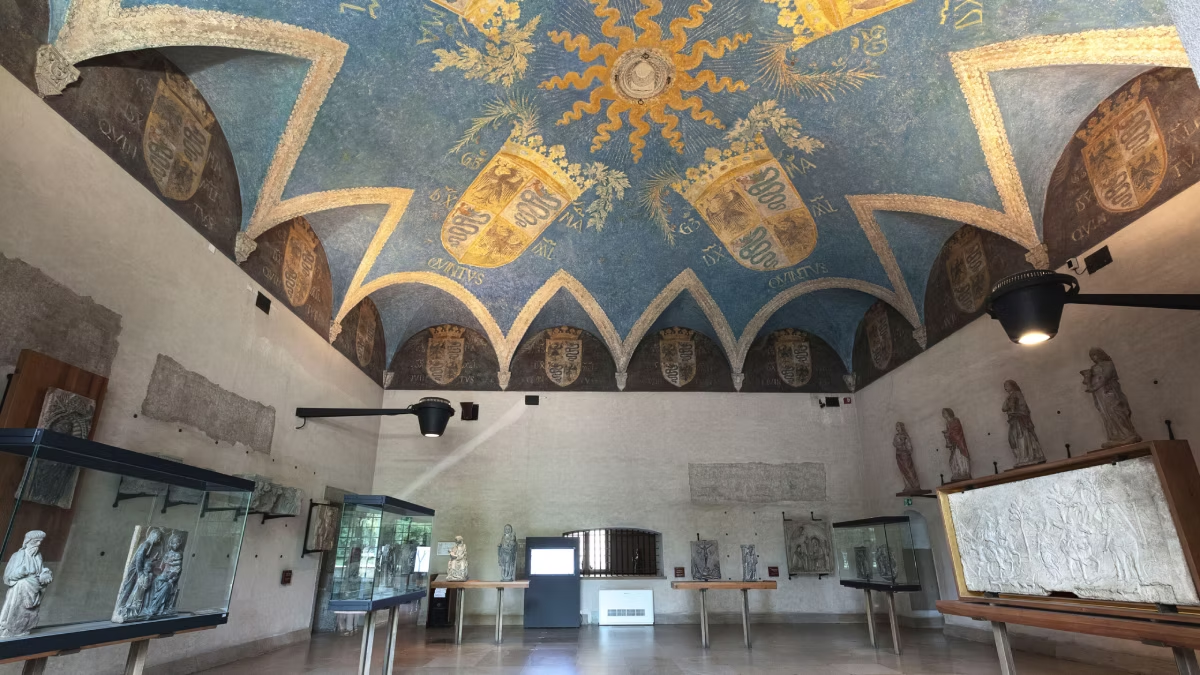
Sforza Castle is one of Europe’s largest citadels, built from 1450 by Francesco Sforza on the ruins of an earlier Visconti fortress. It holds Leonardo da Vinci’s Sala delle Asse ceiling and Michelangelo’s unfinished last work, the Rondanini Pietà. The grounds are free to enter; only the museums inside require a ticket, priced at around €5.
Sforza Castle is easy to walk past as just a big red-brick fortress on the way to Parco Sempione, but there is a lot packed into those walls — a Renaissance court, a demolished-and-rebuilt tower, a Michelangelo sculpture, and a ceiling Leonardo painted for a duke. Below are 20 facts that hold up to scrutiny, with the popular legends clearly labeled as such.
They’re grouped loosely by theme — history, art, architecture, and practical trivia — so skim for whatever interests you most.
Origins and History
1. It stands on the ruins of an earlier, demolished castle.
The current structure isn’t Milan’s first fortress on this spot. The Visconti family built the original Castello di Porta Giovia here starting in 1358; when the Visconti line ended in 1447, Milanese citizens tore much of it down as a hated symbol of ducal power during the short-lived Golden Ambrosian Republic. Francesco Sforza began the present castle in 1450 on those same foundations, which is why historians describe it as “Visconti foundations, Sforza construction.”
2. Francesco Sforza was a mercenary captain, not born nobility.
Francesco Sforza rose as a condottiero — a professional military commander — before marrying Bianca Maria Visconti, the last legitimate Visconti heir, and using that alliance to seize control of Milan. Rebuilding the castle in 1450 was as much a statement of legitimacy as a defensive project, cementing the new Sforza dynasty in the same seat of power the Visconti had held.
3. For centuries it was a military barracks, not a palace.
After the Sforza and later Spanish and Austrian rulers, the castle spent roughly 400 years primarily as a garrison and armory rather than a residence. That long military use is part of why the interiors needed such extensive restoration by the time Milan reclaimed the site for public use around 1900. Our history of Sforza Castle covers this full arc from 1358 to today.
4. Napoleon’s era nearly cost it the castle entirely.
Under Napoleonic rule in the early 1800s, the castle continued as a barracks and there were proposals over the following century to demolish parts of it for urban redevelopment. It survived, and by the 1890s the city had shifted toward preservation instead.
5. Architect Luca Beltrami reshaped it into what you see today.
Around 1900, Beltrami led a major restoration that stripped away later military additions, reconstructed lost elements, and gave the castle much of its present appearance — including rebuilding the central tower. Some of what looks medieval today is, more precisely, a faithful early-1900s reconstruction.
Art and Masterpieces Inside
6. Leonardo da Vinci painted a ceiling here.
The Sala delle Asse, a chamber in the Corte Ducale, has a ceiling and walls painted to look like an arbor of interwoven mulberry tree branches, created around 1498 under Ludovico “il Moro” Sforza, Leonardo’s patron in Milan. It’s one of the few surviving decorative works directly attributed to Leonardo in the city. See our guide to Leonardo’s Sala delle Asse for what it looks like today and how often it’s open.
7. The castle holds Michelangelo’s final work.
The Rondanini Pietà, a marble sculpture Michelangelo was reportedly still reworking just days before his death in 1564, is unfinished and stylistically unlike his earlier, more polished Pietàs. It has been displayed at the castle since the 1950s, now in a dedicated space in the former Spanish Hospital building. Read more in our guide to Michelangelo’s Rondanini Pietà.
8. One ticket covers seven separate collections.
The Musei del Castello Sforzesco include the Museum of Ancient Art, the Pinacoteca (picture gallery), the Museum of Decorative Arts, the Museum of Musical Instruments, the Egyptian Museum, the Prehistoric collections, and the Sala delle Asse — all accessible on a single combined ticket. Our museums overview breaks down what’s in each one.
9. Ludovico Sforza turned the castle into a full Renaissance court.
Beyond commissioning Leonardo, Ludovico “il Moro” also employed the architect Donato Bramante at the castle and in Milan more broadly. Under his rule in the late 1400s, the fortress functioned less as a grim military stronghold and more as a genuine center of art and culture — until the French invasion of 1499 ended Sforza rule.
Architecture and Design
10. The Filarete Tower isn’t the original — it’s a 1905 rebuild.
The tall central gate tower, the castle’s most photographed feature, takes its name from the Renaissance architect Antonio Averlino, known as Filarete, who built the first version. That structure was destroyed in 1521 when a gunpowder store inside exploded — the tower stood ruined for nearly 400 years until Beltrami rebuilt it in 1905 based on historical images and records. Our guide to the castle’s towers has more on this and the other towers.
11. The layout is three distinct courtyards, not one open square.
Piazza d’Armi is the large parade ground, Corte Ducale was the residential heart with the Sala delle Asse, and the Rocchetta was the innermost, most defensible keep — each with a different character and history. Our courtyards guide walks through what to look for in each.
12. It was ringed by a moat that’s dry today.
The castle’s defensive design originally included a water-filled moat around its perimeter, part of a fortification scheme built to withstand artillery in an era when cannon warfare was changing castle design across Europe. The moat is dry now, but its outline is still visible around parts of the walls.
13. Postwar museum design came from a leading Italian architecture studio.
The interior museum spaces were largely redesigned after World War II by BBPR, the modernist studio of Gian Luigi Banfi, Lodovico Barbiano di Belgiojoso, Enrico Peressutti, and Ernesto Nathan Rogers. Their work — completed through the 1950s and 1960s — deliberately contrasts modern display cases and structures against the medieval stone, a design still visible in several galleries today.
14. The castle took real damage in World War II.
Allied bombing in 1943 damaged parts of the complex, including some of the museum collections and buildings, which is part of why the postwar BBPR-led restoration and reinstallation was so extensive.
15. It’s genuinely one of Europe’s largest citadels by footprint.
Between the fortified walls, the three courtyards, and the corner bastions, Sforza Castle covers a substantial urban footprint — regularly cited among the largest citadels on the continent. Walking the full perimeter, from the Filarete Tower around to the far side facing Parco Sempione, takes a good ten to fifteen minutes at a normal pace.
Legends and Curiosities
16. It’s said to have inspired the Kremlin’s distinctive walls.
A popular claim holds that the swallow-tail merlons (the forked battlements) atop the Kremlin walls in Moscow were inspired by Milanese fortress design, including Sforza Castle, since Italian architects — notably Aristotele Fioravanti, who had worked in Milan — were involved in rebuilding the Kremlin in the late 15th century. The Italian design influence on the Kremlin is well documented; the specific claim that Sforza Castle itself was the direct model is a popular, often-repeated story rather than a settled historical fact, so it’s best framed as “said to” rather than confirmed.
17. The Bona Tower is named for a duchess, not a soldier.
The Torre di Bona di Savoia takes its name from Bona of Savoy, wife of Duke Galeazzo Maria Sforza, one of several castle features named for the women of the ruling family rather than for battles or generals.
18. Behind the castle is Milan’s largest central park.
Parco Sempione, laid out in the 1890s on land that had been part of the Sforza family’s parade ground and hunting grounds, sits directly behind the castle and connects visually toward the Arco della Pace at its far end. See our Parco Sempione guide for what’s inside.
Practical Facts Worth Knowing
19. The grounds are free — only the museums are ticketed.
You can walk through the Filarete Tower, cross Piazza d’Armi, and explore the courtyards and ramparts without paying anything; the courtyards are open daily and free at any time. Only the museums inside require the combined ticket, priced at around €5 full price. Our ticket prices guide has the full current breakdown.
20. Museum admission is free on the first Sunday of the month, and always free under 18.
Alongside the standard ~€5 combined ticket, the museums waive admission for everyone on the first Sunday of each month and for visitors under 18 year-round. It’s one of the more affordable major sights in central Milan, especially compared with timed-entry tickets elsewhere in the city.
Frequently Asked Questions
Is Sforza Castle really one of the largest citadels in Europe?
Yes, by footprint it’s regularly cited among the largest citadels on the continent, thanks to its three courtyards, thick perimeter walls, and corner bastions. Walking its full perimeter takes roughly ten to fifteen minutes at a normal pace.
Did Leonardo da Vinci really paint inside Sforza Castle?
Yes. The Sala delle Asse ceiling, painted around 1498 to resemble an arbor of interwoven tree branches, is attributed to Leonardo and was commissioned by his patron Ludovico Sforza. The room is occasionally closed for restoration, so check current access before your visit.
Is the Filarete Tower original?
No. The original 15th-century tower was destroyed in a 1521 gunpowder explosion and stood in ruins for nearly 400 years. The tower visitors see today is a 1905 reconstruction by architect Luca Beltrami, based on historical records.
Why does the castle have Visconti and Sforza history mixed together?
The castle sits on the site of an earlier Visconti fortress built from 1358, which was largely demolished after the Visconti line ended in 1447. Francesco Sforza rebuilt on those foundations from 1450, so the site’s history spans both families even though the standing structure is Sforza-era and later.
Is it true the Kremlin copied Sforza Castle’s design?
It’s a popular and widely repeated claim, tied to the real historical fact that Italian architects worked on rebuilding the Kremlin in the late 15th century. Whether Sforza Castle specifically was the direct model, rather than Italian fortress design more broadly, isn’t settled history, so it’s best treated as a well-known story rather than a confirmed fact.
What is the Rondanini Pietà, and why is it significant?
It’s Michelangelo’s final sculpture, left unfinished at his death in 1564 and stylistically different from his earlier, more classically finished work. It has been housed at Sforza Castle since the 1950s and is one of the most visited single pieces in the museum collections.
Do I have to pay to see Sforza Castle?
No, not to enter the grounds. The courtyards, ramparts, and exterior are free and open daily. You only pay if you want to enter the museums, which cost around €5 combined for all collections.
Who designed the modern museum displays inside?
The postwar museum spaces were largely designed by BBPR, an influential Italian modernist architecture studio, with work completed through the 1950s and 1960s. Their approach deliberately sets modern display structures against the older stone architecture.
What’s directly behind Sforza Castle?
Parco Sempione, Milan’s largest central park, begins right behind the castle and stretches toward the Arco della Pace. It occupies land that was once part of the Sforza family’s own parade and hunting grounds.
How old is the current castle structure?
Construction began in 1450 under Francesco Sforza, making the core structure over 570 years old, though the site’s fortress history goes back to 1358 under the Visconti family, and much of what’s visible today reflects a major restoration completed around 1905.
