

Sforza Castle Free Courtyards: Piazza d’Armi & Rocchetta
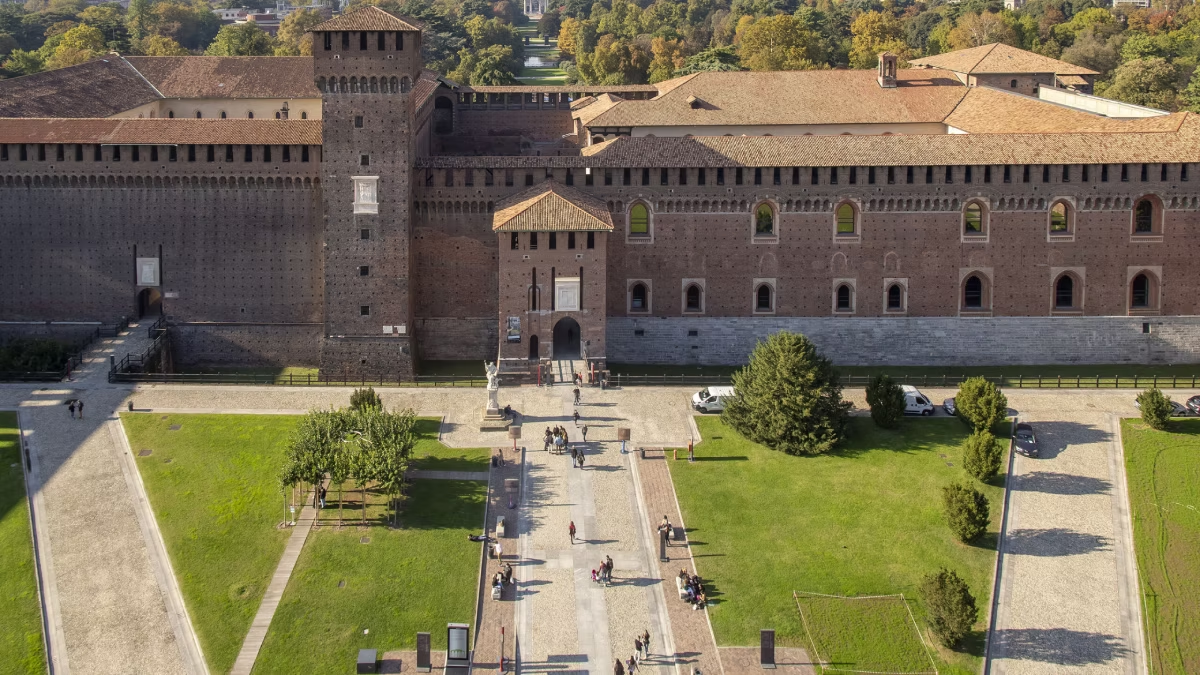
Sforza Castle is built around three linked courtyards, and all three are free to enter, no ticket required: the vast Piazza d’Armi parade ground just inside the Filarete Tower, the elegant Corte Ducale where the museum entrances sit, and the Rocchetta, the fortified inner keep and the best-preserved part of the complex. A fourth, smaller space, the Cortile della Fontana, sits inside the Rocchetta around a restored fountain. You can walk through all four in about 20–30 minutes, longer if you linger for photos.
Most visitors think of Sforza Castle as a single building, but it is really a sequence of courtyards, each walled off from the next and each with its own character. You pass through them in order as you walk from Piazza Castello toward Parco Sempione, and the shift from one to the next — open parade ground, then refined ducal court, then tight fortified keep — is part of what makes a walk through the castle worthwhile even if you never buy a museum ticket.
This guide covers all three main courtyards plus the Cortile della Fontana: what each one is, what to look for architecturally, where the museum entrances are, and the route that connects them. The one fact worth repeating up front: none of this costs anything. The courtyards are open grounds, not part of the ticketed museums inside.
The Courtyards at a Glance
| Courtyard | What it is | Cost | Highlights |
|---|---|---|---|
| Piazza d’Armi | Huge open parade ground | Free | Scale, city-wall views, gateway to Parco Sempione |
| Corte Ducale | Ducal residence courtyard | Free (museum entrances ticketed) | Bramante-attributed loggia elements, museum doors |
| Rocchetta | Fortified inner keep | Free (Sala delle Asse ticketed when open) | Best-preserved architecture, Sala delle Asse tower |
| Cortile della Fontana | Small fountain court inside the Rocchetta | Free | The restored fountain, quiet corner for photos |
All four spaces are open during the castle’s daily grounds hours; only the doorways leading into the museum rooms around them require a ticket. See our opening hours guide for the current daily times.
Piazza d’Armi — The Grand Parade Ground
Piazza d’Armi is the first and largest courtyard, entered directly through the Filarete Tower. It was the castle’s military parade ground and is now simply open lawn and gravel, free to cross at any hour the grounds are open, with clear views back to the tower and forward toward Parco Sempione.
Step through the Filarete Tower and you’re immediately in Piazza d’Armi, and the scale is the first thing that registers. This is genuinely one of the largest courtyards of any European citadel — open, mostly grass and gravel today, framed by the long brick curtain walls on either side. In its working life this was where troops assembled and drilled; now it’s the calmest part of the castle, a place locals cut through on a bike or walk a dog rather than a tourist stop in itself.
Because it’s so large and so open, Piazza d’Armi is also the best spot to appreciate the castle’s size as a whole. Turn around and the Filarete Tower frames the view back toward Piazza Castello and the city; walk to the far end and you reach the low wall and gate that lead out to Parco Sempione, with the Arco della Pace visible in the distance on a clear day. There’s no ticket booth, no gate to pass, and no reason not to linger — it’s simply part of the free walk through the castle grounds.
Corte Ducale — The Ducal Residence Court
Corte Ducale is the smaller, more architecturally refined courtyard on the castle’s south side, once the residence of the Sforza dukes. It’s free to stand in and photograph; the doors around its perimeter lead into the ticketed museum rooms, including elements attributed to the architect Donato Bramante.
Where Piazza d’Armi is scale, Corte Ducale is detail. This was the residential heart of the castle — the court the Sforza family actually lived around — and it shows in the architecture: arched loggias, decorative brickwork, and stone portals that are considerably more refined than the plain military walls of the parade ground. Several of the loggia and portal elements here are attributed to Donato Bramante, who worked at the Sforza court in Milan in the late 15th century, though attribution on parts of the complex is debated among historians and the castle’s own materials are careful about what’s confirmed.
Corte Ducale is also where most of the museum entrances open off the courtyard — the doors into the Museum of Ancient Art, the Pinacoteca, and the other collections are set into its walls. You don’t need a ticket to stand in the courtyard itself and look at the facades; you only pay when you step through one of those doorways into the collections. That’s worth knowing if you’re short on time or budget: you can see a good deal of the castle’s best architecture — this courtyard included — without spending a euro, and only decide about the museums once you’re standing there.
Rocchetta — The Fortified Inner Keep
The Rocchetta is the innermost, most heavily fortified courtyard, built as a last line of defense and refuge for the ducal family. It’s the best-preserved part of the whole complex, free to enter, and home to the tower containing Leonardo da Vinci’s Sala delle Asse, which is separately ticketed and often closed for restoration.
Beyond Corte Ducale, a narrower passage leads into the Rocchetta — literally “the little fortress” — the innermost and most defensible courtyard of the castle. This is where the Sforza family and their court would have retreated in a real siege, and the architecture reflects it: thicker walls, a tighter footprint, and towers at the corners rather than open loggias. Of the three courtyards, the Rocchetta reads most clearly as a fortress rather than a palace, and it’s generally considered the most intact and least altered part of the whole complex, having survived later military use and 20th-century restoration better than the other sections.
The Rocchetta’s northeast tower holds the Sala delle Asse, the room Leonardo da Vinci decorated with a painted ceiling of interwoven mulberry branches. Seeing it requires the museum ticket, and even then it’s worth checking ahead — the room is delicate and closes for restoration work fairly often, so don’t build a visit entirely around it without confirming access on the official site first. The courtyard around the tower, though, is free and open every day the grounds are, and the tower itself is one of the best-looking structures in the castle from the outside.
Cortile della Fontana — The Fountain Courtyard
The Cortile della Fontana is a small, quiet courtyard tucked inside the Rocchetta, centered on a restored fountain. It’s free, easy to miss if you’re moving quickly, and one of the more atmospheric photo spots in the castle.
Inside the Rocchetta, and easy to walk past if you’re not looking for it, is the Cortile della Fontana — a small enclosed court built around a fountain. It’s a modest space compared with the other three, but it’s also one of the quietest and most photogenic corners of the castle: enclosed brick walls on all sides, the fountain as a focal point, and none of the through-traffic of Piazza d’Armi. It’s worth the short detour, particularly earlier or later in the day when the crowds moving between the tower and the museums have thinned out.
How the Courtyards Connect — The Route Through
The four spaces sit in a fairly linear sequence from the city side to the park side, which makes the castle easy to walk without a map:
- Enter through the Filarete Tower on the Piazza Castello side. This drops you straight into Piazza d’Armi.
- Cross Piazza d’Armi toward the south side of the complex, where the walls narrow and the architecture becomes more decorative — this is the approach to Corte Ducale.
- Pass into Corte Ducale, where the museum entrances line the courtyard. Decide here whether you want to buy a ticket and go in, or continue on for free.
- Continue through to the Rocchetta, the innermost fortified court, and look for the Sala delle Asse tower at its corner.
- Step into the Cortile della Fontana, tucked inside the Rocchetta, for the quietest stop on the route.
- Exit toward Parco Sempione from the far end of Piazza d’Armi if you want to continue the walk, or double back the way you came.
The whole loop is walkable in 20–30 minutes at an easy pace, more if you stop for photos or sit for a while — there’s no route to get wrong, since each courtyard leads naturally into the next. For a fuller sense of where everything sits relative to the towers, ramparts, and museum wings, our castle map lays out the whole layout at a glance.
Architecture to Notice
Each courtyard rewards a slightly different kind of looking. In Piazza d’Armi, look up at the scale of the curtain walls and the Filarete Tower itself — most of what you see was reconstructed around 1900 by the architect Luca Beltrami, working from historical images, after the original tower had been demolished centuries earlier. In Corte Ducale, look for the rhythm of the arched loggias, the terracotta decoration, and the carved stone portals around the courtyard’s edges — this is Renaissance court architecture at its most confident. In the Rocchetta, notice how much plainer and heavier the walls feel by comparison; this courtyard was built to be defended, not admired, and the difference in tone from Corte Ducale next door is deliberate.
The Fountain and the Atmosphere
The fountain in the Cortile della Fontana is modern in its current form — restored, not original medieval fabric — but it does the job of giving the smallest courtyard a focal point and a bit of sound and movement that the larger, harder-surfaced courtyards lack. Overall, the atmosphere shifts noticeably as you move through the sequence: Piazza d’Armi feels civic and open, almost like a city park; Corte Ducale feels formal and architectural; the Rocchetta feels enclosed and a little more solemn. Visiting in the early morning or the last hour before closing brings out this contrast best, since the courtyards are close to empty and the low light catches the brickwork well.
Best Photo Spots
- Piazza d’Armi, looking back at the Filarete Tower — the classic wide shot, best with the tower backlit in early morning or golden-hour light.
- Corte Ducale’s loggias — shoot along the arcade for the strongest architectural lines, ideally when the courtyard isn’t crowded with museum-goers passing through.
- The Rocchetta’s corner tower — the Sala delle Asse tower reads well from the courtyard below even if you don’t go inside.
- Cortile della Fontana — the enclosed, symmetrical framing around the fountain makes for one of the most intimate shots in the whole castle.
- The passage between courtyards — the narrow transitions, where thick stone archways frame the next open space, are an easy way to capture the sense of moving deeper into the fortress.
Frequently Asked Questions
Is it free to enter the Sforza Castle courtyards?
Yes. All three main courtyards — Piazza d’Armi, Corte Ducale, and the Rocchetta — plus the Cortile della Fontana are free and open to the public every day during the castle’s grounds hours. You only pay for a ticket if you step into one of the museum rooms around their edges.
What’s the difference between Piazza d’Armi, Corte Ducale, and the Rocchetta?
Piazza d’Armi is the large open parade ground just inside the Filarete Tower. Corte Ducale is the smaller, more decorative courtyard that was the ducal family’s residence and holds most of the museum entrances. The Rocchetta is the innermost, most heavily fortified courtyard, built as a defensive last resort and now the best-preserved part of the castle.
Do I need a ticket to walk through the courtyards?
No. Walking through all three courtyards and the Cortile della Fontana requires no ticket at any time the grounds are open. A ticket is only needed for the museum galleries and the Sala delle Asse, which open off the courtyards rather than being part of them.
Where is the Sala delle Asse located?
The Sala delle Asse, the room with Leonardo da Vinci’s painted ceiling, is in a tower at the corner of the Rocchetta, the innermost courtyard. Access to the room itself requires the museum ticket, and it periodically closes for restoration, so check the official site before counting on seeing it.
How long does it take to walk through the courtyards?
Walking the full route — Piazza d’Armi, Corte Ducale, the Rocchetta, and the Cortile della Fontana — takes about 20–30 minutes at a relaxed pace without stopping for the museums. Add extra time for photos, since each courtyard has a different character and rewards a slower look.
Which courtyard has the fountain?
The fountain is in the Cortile della Fontana, a small enclosed court tucked inside the Rocchetta. It’s easy to walk past if you’re moving quickly between the tower and the museum entrances, so it’s worth deliberately seeking out.
Can I take photos in the courtyards?
Yes, general photography in the free outdoor courtyards is unrestricted for personal use. Rules can differ once you’re inside the ticketed museum galleries, where flash and tripods are often limited, so check posted signage there.
Are the courtyards accessible to wheelchairs and strollers?
The main courtyards are largely flat, paved or gravel surfaces and are generally manageable, though some transitions between courtyards use stone thresholds or gentle ramps rather than perfectly level ground. See our accessibility guide for specifics before visiting if mobility is a concern.
Are the courtyards open on Mondays?
Yes. The courtyards and grounds are open daily, including Mondays, even though the museums close on Mondays. A Monday visit is actually a good option if you only want to see the free courtyards and architecture without the museum crowds.
What’s the best time of day to visit the courtyards?
Early morning, soon after the grounds open, and the hour before closing are the quietest times, with softer light for photos and far fewer people crossing Piazza d’Armi. Midday and early afternoon are the busiest, especially when tour groups are moving between the Filarete Tower and the museum entrances in Corte Ducale.
