

Sforza Castle Accessibility: Wheelchair Access Guide 2026
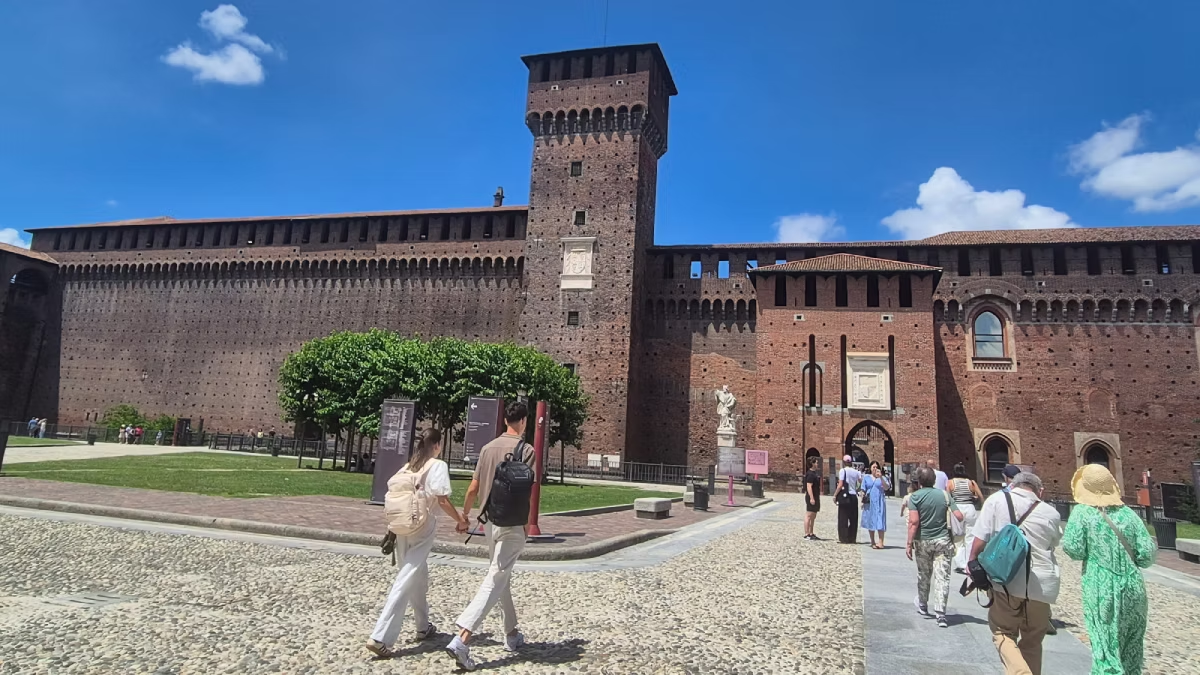
Sforza Castle’s courtyards are step-free but paved in bumpy cobblestone, so wheelchair and stroller users can get around with some jostling. Most of the museums have lifts or ramps to the main collections, including the Rondanini Pietà, though a few upper rooms in the historic Rocchetta remain harder to reach. Disabled visitors and one companion get free museum entry, and the nearest step-free metro exits are at Cadorna.
Sforza Castle is a working medieval and Renaissance fortress, not a purpose-built modern museum, so accessibility here is a mix of good, workable, and genuinely limited. The good news is that the free courtyards — where most people spend their time anyway — are flat and open, and the ticketed museums have invested in lifts and ramps for their main routes. The honest news is that a 15th-century citadel built for horses and soldiers still has thresholds, cobblestones, and a handful of steps that no renovation has fully solved.
This guide walks through what to expect at each stage of a visit: getting from the metro, crossing the courtyards, moving through the museums (including the Rondanini Pietà), using the toilets, and where to ask for help if something isn’t clear on the day. If you need guaranteed step-free routing for a specific gallery, it’s always worth calling ahead — museum layouts and lift availability can change with ongoing restoration work.
Step-Free Route from the Metro
The most reliable step-free approach is via Cadorna (M1/M2), which has lift access and opens onto a short, flat walk to the castle’s back entrance near Parco Sempione. Cairoli Castello (M1) is closer to the main Filarete Tower entrance but its lift access can be less consistent, so check current status before relying on it.
Milan’s metro system has improved lift access over the years, but coverage still varies by station. Cadorna is generally the more dependable step-free option, with elevators connecting the platforms to street level; from there it’s a flat, paved walk of a few minutes to the castle grounds through Parco Sempione. Cairoli Castello sits right at the castle’s main square and is the shortest walk to the Filarete Tower, but wheelchair users should confirm lift service is running that day, since not every entrance/exit at every station is step-free. Lanza (M2) is another nearby option worth checking if Cairoli’s lift is out of service. For a full breakdown of routes, trams, and walking times, see our guide on how to get to Sforza Castle.
If you’re arriving by taxi or accessible transport, drop-off directly on Piazza Castello or Foro Buonaparte gives the shortest distance to the entrance, avoiding both the metro stairs question and the longer walk from Cadorna.
Wheelchair Access to the Courtyards and Grounds
The castle’s courtyards and grounds are step-free and free to enter, but the paving is historic cobblestone — bumpy in a wheelchair or stroller, though flat enough that most visitors manage it without major difficulty. A smoother alternative is the Parco Sempione side, which has paved paths.
Once through the Filarete Tower gate, Piazza d’Armi (the great parade courtyard) is wide open and level, so there’s no gradient to fight — the challenge is purely the texture of the stone. Cobblestones here are old and uneven in places, which means a wheelchair user will feel some vibration and needs to move a bit slower than on smooth pavement, and manual wheelchair users may want a companion’s help on the roughest stretches. The Corte Ducale, the inner courtyard closer to the museum entrances, has similar paving. None of the courtyards involve steps or curbs to get in, and the courtyards themselves — the real highlight for many visitors, since they’re free — are accessible to anyone who can manage moderately rough ground.
If cobblestones are a hard limit for you, the paved paths through Parco Sempione behind the castle offer a smoother, still-scenic walk, and you can view the castle’s rear facade and the Arco della Pace without crossing the roughest stone.
Museum Accessibility: Lifts, Ramps and Step-Free Routes
Most of the Musei del Castello Sforzesco’s main galleries are reachable by lift or ramp, including the ground-floor Museum of Ancient Art and the Rondanini Pietà. Some upper-floor rooms in the older Rocchetta wing have limited or no lift access, so a fully step-free tour of every single gallery isn’t always possible.
The museums occupy several connected historic buildings, and accessibility has been retrofitted room by room rather than designed in from the start, so it varies by collection. The Museum of Ancient Art and the Pinacoteca (picture gallery) generally have step-free or lift-assisted routes through their main halls. The Egyptian Museum and Prehistoric collections, housed in restored ground-floor spaces, are also reasonably accessible. The Museum of Musical Instruments and Museum of Decorative Arts include some sections on upper floors of the older Rocchetta, where lift coverage is more limited — staff can usually direct you to whichever lift serves that wing, but a couple of smaller rooms may only be reachable by stairs. Leonardo’s Sala delle Asse, when open (it’s frequently closed for restoration — check before you go), sits in a section with variable access, so ask at the ticket desk on the day.
Wheelchairs are welcome throughout, and the museums can usually lend one at the entrance if you need it for the visit — ask when you arrive. Because layouts and lift status can shift with ongoing conservation work across the complex, don’t assume last year’s blog post or a general travel forum reflects this year’s routing; a quick call to the museum ahead of your visit is the most reliable way to confirm access to a specific gallery. For an overview of what’s inside each collection, see our guide to the Sforza Castle museums.
Accessing the Rondanini Pietà
Michelangelo’s Rondanini Pietà, his last and unfinished work, is displayed in the former Spanish Hospital space within the museum complex — a purpose-adapted room built specifically to house the sculpture, which makes it one of the more consistently accessible highlights. The approach is generally step-free from the main ground-floor museum route, and the room itself is spacious, designed for visitors to circle the statue. If you’re visiting primarily for the Pietà and want to confirm the easiest route on a given day, mention this at the ticket desk or ask a staff member near the entrance — they can point you to the shortest step-free path rather than the general visitor route through every gallery in sequence.
Accessible Toilets
Accessible toilets are available within the museum complex, near the main visitor facilities inside the Corte Ducale. There are no accessible public toilets in the free outdoor courtyards themselves, so if you only plan to walk the grounds without visiting the museums, you may need to plan around this or use facilities in Parco Sempione or a nearby café. Ask staff at the museum entrance for the closest accessible toilet, since exact locations can shift with any given renovation work.
Free and Reduced Entry for Disabled Visitors and Companions
Visitors with a disability typically receive free museum entry, along with one accompanying companion or caregiver, following the general Italian state and municipal museum practice. Bring documentation if you have it, though staff are generally accommodating even without formal paperwork.
Italian civic museums, including the Musei del Castello Sforzesco, commonly waive the entry fee for visitors with disabilities and for the companion or caregiver accompanying them — this follows widely applied national and municipal policy rather than being unique to the castle. Given the museum ticket is already inexpensive (around €5 full price), this mainly matters for the companion, who would otherwise pay separately. Exact documentation requirements can vary, so it’s worth having a disability card, medical certificate, or similar proof if you have one, though front-desk staff typically handle this with common sense rather than strict bureaucracy. Combine this with the site’s other free-entry provisions — the courtyards are always free regardless, under-18s are free, and the first Sunday of the month is free for everyone — covered in full in our guide to Sforza Castle free entry.
If you’re booking a reserved slot rather than buying at the door, mention accessibility needs at the time of booking so staff can flag it and have any assistance or wheelchair loan ready when you arrive.
Strollers and Prams
Strollers face the same conditions as manual wheelchairs: no steps to get in, but cobblestones to roll over in the courtyards, and mixed lift coverage inside the museums. Most parents find the courtyards manageable with a standard stroller, if a little bumpy, and the museums’ main routes are stroller-friendly where lifts are available. As with wheelchairs, the older upper-floor rooms in the Rocchetta are the spots most likely to require carrying a stroller up a short flight of stairs, so ask staff if you’d rather avoid that.
Sensory and Quiet Notes
Sforza Castle can get loud and crowded, especially the main Piazza d’Armi courtyard on weekends and around midday, when tour groups and school trips pass through together. For visitors sensitive to noise or crowds, early morning — right at the grounds’ 7:00 AM opening or shortly after the museums open at 10:00 AM — is noticeably calmer. The museum galleries themselves are generally quiet, climate-controlled indoor spaces without the echoing acoustics of, say, a cathedral, which some sensory-sensitive visitors find easier than other Milan attractions. There’s no dedicated quiet room or sensory space on site, but the smaller side courtyards (away from the central Piazza d’Armi) offer a lower-stimulation outdoor spot to pause if needed.
Where to Ask for Assistance
Staff at the ticket desks, near the Filarete Tower entrance and inside the main museum entrance in the Corte Ducale, are the best first point of contact for any accessibility question on the day — wheelchair loans, the current status of a specific lift, step-free routing to a particular gallery, or locating the nearest accessible toilet. If you have specific needs (a particular gallery you want to guarantee access to, a large mobility device, or a group with mixed needs), contacting the museum in advance by phone or through the official Castello Sforzesco website is more reliable than relying on staff to improvise a solution on a busy day. For a guided visit with someone who can manage the route for you, a private or small-group tour that includes the Rondanini Pietà can also take some of the planning burden off your shoulders.
Frequently Asked Questions
Is Sforza Castle wheelchair accessible?
Largely yes, with caveats. The free courtyards are step-free but paved in bumpy cobblestone, and most of the ticketed museums have lifts or ramps to their main galleries, including the Rondanini Pietà. A few upper-floor rooms in the older Rocchetta wing have limited lift access, so a handful of smaller spaces may not be reachable by wheelchair.
Are the courtyards accessible, or just the museums?
The courtyards are the more consistently accessible part of a visit — flat, step-free, and free to enter, with cobblestone as the only real obstacle. The museums require more care, since access varies by gallery and depends on which lifts are running that day.
Can I visit the Rondanini Pietà in a wheelchair?
Yes, generally. The Rondanini Pietà is displayed in a purpose-adapted room within the museum complex, with a step-free approach from the main ground-floor route in most cases. Ask staff at the entrance to confirm the shortest accessible path on the day of your visit.
Is the Sala delle Asse accessible?
Access varies, and the Sala delle Asse is frequently closed for restoration regardless of mobility needs, so confirm it’s open before planning around it. When it is open, ask staff about step-free routing, since that section of the complex has mixed lift coverage.
Do disabled visitors get free entry to Sforza Castle?
The courtyards are always free for everyone. For the museums, visitors with a disability typically receive free entry along with one accompanying companion, following standard Italian museum practice — bring documentation if you have it, though staff are generally accommodating.
Are there accessible toilets at Sforza Castle?
Yes, accessible toilets are available inside the museum complex near the main visitor facilities in the Corte Ducale. There are no accessible public toilets in the outdoor courtyards themselves, so plan accordingly if you’re only visiting the free grounds.
What’s the easiest step-free way to reach the castle?
Cadorna (M1/M2) is generally the more reliable step-free metro option, with lift access to a short, flat walk through Parco Sempione. Cairoli Castello is closer to the main entrance but lift service there can be less consistent, so check current status before relying on it.
Can I bring a stroller?
Yes. Strollers handle the same as wheelchairs: no steps into the courtyards, some bumpiness on the cobblestones, and step-free routes through most of the museums via lifts. A few upper-floor rooms may require carrying the stroller up a short staircase.
Are wheelchairs available to borrow on site?
The museums can usually lend a wheelchair at the entrance for your visit — ask when you arrive, or call ahead if you want to guarantee availability. This is worth doing in advance if you’re visiting during a busy period.
Who do I ask if I need help on the day?
Staff at the ticket desks near the Filarete Tower entrance and the main museum entrance in the Corte Ducale can help with wheelchair loans, current lift status, and directions to accessible toilets. For anything more specific, contacting the museum in advance by phone is more reliable than working it out on arrival.
