

Sala delle Asse: Leonardo’s Painted Room at Sforza Castle
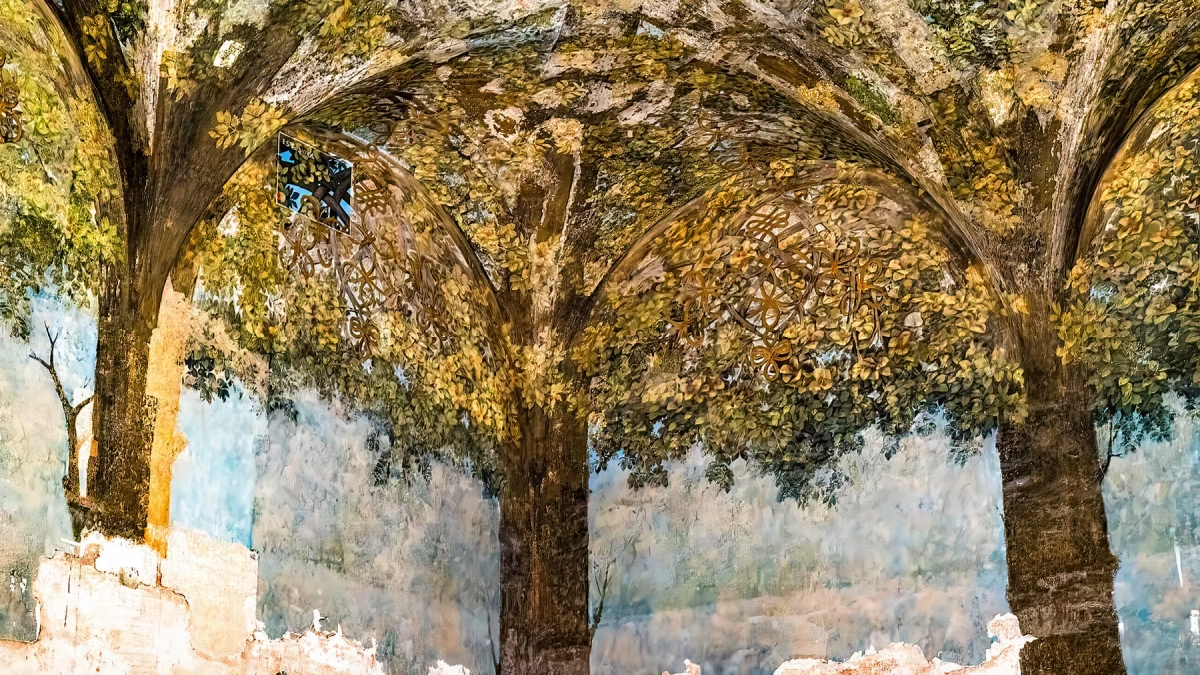
The Sala delle Asse is a chamber in the Rocchetta tower of Sforza Castle where Leonardo da Vinci painted the vault, around 1498, as an illusionistic canopy of sixteen intertwining mulberry trees. It has a long, difficult restoration history and is frequently closed, partly closed, or open only on limited days, so check current access on the official site before you plan a visit around it.
Of everything inside Sforza Castle, the Sala delle Asse is the room art lovers travel for — and the one most likely to disappoint someone who assumes it will simply be open. It is a genuine Leonardo da Vinci work in situ, not a copy or a reconstruction, but decades of damage, over-restoration, and ongoing conservation mean the room’s availability changes often. This guide explains what the Sala delle Asse actually is, what survives on its walls and ceiling, why it keeps closing, and how to find out whether you can see it on the day you visit.
What the Sala delle Asse Is
The Sala delle Asse (“Room of the Wooden Boards,” named for the timber paneling that once lined its walls) sits at ground level in the Torre della Rocchetta, the inner keep of Sforza Castle. Ludovico Sforza, known as “il Moro,” commissioned Leonardo da Vinci to decorate the vaulted ceiling around 1498, near the end of Leonardo’s first long stay in Milan and shortly before the fall of Sforza rule to the French. It was one of several decorative commissions Leonardo carried out for the Sforza court alongside his better-known work on the Last Supper at nearby Santa Maria delle Grazie.
Rather than a conventional fresco of figures or scenes, Leonardo turned the vault into an illusion: the room reads as if it were open to the sky, with the actual stone ribs of the vault absorbed into a dense, painted grove of trees. It is one of the few surviving decorative interiors that can be attributed directly to Leonardo, which is what makes it significant enough to draw visitors even though — as this guide is honest about — it is far from guaranteed to be open or fully visible when you arrive.
The Painted Canopy of Mulberry Trees
The ceiling shows sixteen mulberry trees, their trunks rising from the corners and edges of the room and their branches interlacing overhead into a continuous canopy, bound together by knotted golden cords. The mulberry, or moro in Italian, is a visual pun on Ludovico “il Moro” Sforza’s own nickname.
Leonardo painted sixteen trees, evenly spaced around the room, their trunks emerging from a low rocky outcrop that runs along the base of the walls. Above head height, the branches fan out and interweave across the vault, layering into a canopy dense enough to obscure the architecture beneath it — the ribs and lunettes of the actual vault become, in the painting, simply more branches. Threaded through the foliage is a golden cord that knots and loops around the branches in an intricate, continuous pattern, a motif Leonardo used elsewhere in his decorative and technical drawings and one closely associated with his workshop.
The species is the mulberry — moro in Italian — and the choice is not incidental. It is a pun on Ludovico Sforza’s own epithet, “il Moro,” making the room a piece of dynastic self-presentation as much as a work of art: an artificial grove that turns the duke’s nickname into the room’s entire decorative program. Traces of the ceiling’s original color scheme, along with the coats of arms of the Sforza and Visconti families worked into the design, place the room firmly in the context of Ludovico’s court at its height, shortly before it collapsed.
The Monochrome Fragment and the Wall Drawings
Above the canopy of branches, in the lunettes near the springing of the vault, restorers uncovered a further layer of the decoration: a monochrome section painted in tones of brown and black rather than the greens and golds of the main scheme. This area, sometimes called the “monochrome fragment,” shows root systems and rocky outcrops rendered almost like a technical or geological study, closer to a drawing than a finished painting. It was hidden under later whitewash and overpainting for centuries and only became visible again through twentieth-century conservation work, which is part of why it is less well known to visitors than the mulberry canopy itself.
The monochrome sections are usually read as evidence of Leonardo’s own working method and his interest in the mechanics of plant growth — how roots anchor a tree, how a trunk splits into branches — the same curiosity that shows up in his botanical and geological notebooks. Because this area is more fragile and less complete than the main ceiling, it is often the first part of the room to be roped off or unavailable even when the rest of the Sala delle Asse is open.
Damage, Over-Restoration and a Difficult History
The Sala delle Asse suffered heavy damage and loss over the centuries — through whitewashing, use as stables and storage, and restoration campaigns (particularly in the early twentieth century) that repainted large areas rather than conserving what survived. Much of what visitors see today is reconstruction layered over a damaged original, and conservators continue to debate how much of the visible decoration is genuinely Leonardo’s hand.
The room’s condition today is the result of centuries of hard use and well-intentioned but damaging intervention, not a single accident. After the Sforza dynasty fell, the castle passed through Spanish, Austrian, and eventually Italian military hands, and the Sala delle Asse was whitewashed and repurposed, at points serving as a stable or storeroom rather than a decorated chamber. The painted surface was covered over and largely forgotten for roughly three centuries.
When the room was rediscovered and restored around the turn of the twentieth century, under the broader restoration of the castle led by Luca Beltrami, conservators repainted extensively rather than simply cleaning and stabilizing the surviving fragments — a common approach at the time but one that art historians now regard as having obscured, and in places replaced, Leonardo’s original work. Later twentieth- and twenty-first-century conservation campaigns have tried to separate genuine surviving pigment from the earlier restorers’ additions, uncovering the monochrome fragment in the process, but the room’s condition means large stretches of what you see are best understood as a heavily restored interpretation of the original rather than an untouched Renaissance surface.
Ongoing Restoration and Why It’s Often Closed
The Sala delle Asse has been the subject of extended, multi-year conservation projects, and access has repeatedly been limited — closed entirely, open only to part of the room, or viewable on restricted days or through a viewing window rather than full entry. There is no fixed schedule for this: check the official Castello Sforzesco site immediately before your visit rather than assuming the room is open.
This is the single most important practical fact about the Sala delle Asse, and it is worth being direct about: you should not build a Milan itinerary around seeing this room without confirming, close to your travel date, that it is accessible. Conservation of a fragile, centuries-old painted surface is slow, technical work, and the castle has closed the room for extended restoration campaigns more than once, sometimes for a year or longer at a stretch. Even when restoration isn’t actively underway, the room’s fragility means opening hours can be more limited than the rest of the museums, or access may be granted only to the outer part of the chamber while conservators continue work on the more delicate sections.
None of this is unique to Milan — fragile Renaissance wall and ceiling paintings everywhere require this kind of careful, intermittent management, and it is a sign the room is being taken seriously rather than a reason to distrust it. But it does mean the honest advice is: check the official Castello Sforzesco website or call ahead in the days before your visit, and treat the Sala delle Asse as a possible highlight of your trip rather than a certainty. If access matters enough to you that you’d be disappointed to miss it, build in flexibility, or ask your accommodation to check the day before.
What You Can See When It’s Open
When the Sala delle Asse is accessible, entry is included in the single combined museums ticket that covers all of Sforza Castle’s collections — there is no separate charge for the room itself. Visits are typically brief; this is a single chamber, not a large gallery, and the main experience is standing beneath the vault and looking up into the interlaced canopy, taking in how the trunks at the wall base give way to the woven branches overhead. Because the room is compact and the surface is fragile, expect a controlled, unhurried but time-limited visit rather than a space to linger for a long stretch, and expect signage or a room guide explaining which sections are original, restored, or reconstructed.
Photography rules can vary depending on the current conservation status, and on days when only partial access is granted, you may view the room through a doorway or barrier rather than walk fully inside. None of this diminishes what’s there to see — it simply means the experience is more tightly managed than a typical museum gallery, precisely because of everything the room has already been through.
Significance
The Sala delle Asse matters because it is one of the very few surviving decorative environments that can be attributed to Leonardo da Vinci — most of his other work in Milan either no longer exists (his lost equestrian monument for Francesco Sforza), has suffered its own severe deterioration (the Last Supper), or survives only in drawings and notebooks. A ceiling you can stand beneath, painted for the Sforza court at the height of its confidence, connects the abstract genius of Leonardo’s notebooks to an actual room people once lived and worked in. That the room is damaged, heavily restored, and often closed doesn’t erase that significance — if anything, it’s a reminder of how rare and hard-won access to authentic Renaissance interiors really is, and why Milan’s conservators continue to treat it with such caution.
Frequently Asked Questions
What is the Sala delle Asse?
The Sala delle Asse is a chamber in the Rocchetta tower of Sforza Castle whose vaulted ceiling Leonardo da Vinci painted around 1498 for Ludovico Sforza. It shows an illusionistic canopy of sixteen intertwining mulberry trees bound with knotted golden cords, turning the actual stone vault into what looks like a living grove.
Why are the trees mulberries?
The mulberry tree is called moro in Italian, which is a direct pun on Ludovico Sforza’s nickname, “il Moro.” The choice of tree ties the room’s decoration to the duke’s own identity, making it a piece of dynastic imagery as much as a botanical study.
Is the Sala delle Asse open now?
It changes often. The room has a long history of extended restoration closures and periods of partial or limited access, so there is no reliable standing answer — check the official Castello Sforzesco website or call ahead close to your visit date rather than assuming it will be open.
Do I need a separate ticket for the Sala delle Asse?
No. When it is accessible, the Sala delle Asse is included in the single combined museums ticket that covers all of Sforza Castle’s collections. There is no extra charge for this room specifically.
Why is the ceiling so damaged?
The room was whitewashed and used for other purposes for roughly three centuries after the Sforza dynasty fell, and an early twentieth-century restoration repainted large areas rather than conserving the surviving original. Later conservation work has tried to separate genuine Leonardo-era pigment from these later additions.
What is the “monochrome fragment”?
It’s a section of brown-and-black painted decoration, showing roots and rocky outcrops, found in the lunettes above the main canopy. It was hidden under whitewash for centuries and rediscovered during twentieth-century restoration, and it’s often read as evidence of Leonardo’s working process.
How long does a visit to the room take?
Not long — it’s a single chamber, and most visitors spend a few minutes taking in the ceiling before moving on to the rest of the museums. Time inside can also be limited by current conservation restrictions.
Is the Sala delle Asse worth planning a trip around?
It’s worth seeing if it happens to be open during your visit, but given how often it closes for restoration, it’s safer to treat it as a bonus within a broader Sforza Castle visit rather than the sole reason for your trip. Our guide on whether Sforza Castle is worth it covers the rest of what’s inside.
Where exactly is the room located?
The Sala delle Asse is in the Torre della Rocchetta, the inner keep at the back of the castle complex, reached through the museum route once you’re past the main courtyards. Our Sforza Castle courtyards guide explains how the Rocchetta relates to the rest of the layout.
Can I photograph the ceiling?
Photography policy can shift depending on the room’s current conservation status, so check signage on-site. On days with only partial access, you may not be able to get close enough for a full shot of the vault.
